VSE Corporation0000102752PRE 14Afalseiso4217:USDxbrli:pure00001027522025-01-012025-12-3100001027522024-01-012024-12-3100001027522023-01-012023-12-3100001027522022-01-012022-12-3100001027522021-01-012021-12-310000102752ecd:AggtChngPnsnValInSummryCompstnTblForAplblYrMemberecd:PeoMember2025-01-012025-12-310000102752ecd:PnsnAdjsSvcCstMemberecd:PeoMember2025-01-012025-12-310000102752ecd:PnsnAdjsPrrSvcCstMemberecd:PeoMember2025-01-012025-12-310000102752vsec:SummaryCompensationTableStockAwardsColumnValueMemberecd:PeoMember2025-01-012025-12-310000102752vsec:SummaryCompensationTableOptionAwardsColumnValueMemberecd:PeoMember2025-01-012025-12-310000102752ecd:YrEndFrValOfEqtyAwrdsGrntdInCvrdYrOutsdngAndUnvstdMemberecd:PeoMember2025-01-012025-12-310000102752ecd:ChngInFrValOfOutsdngAndUnvstdEqtyAwrdsGrntdInPrrYrsMemberecd:PeoMember2025-01-012025-12-310000102752ecd:VstngDtFrValOfEqtyAwrdsGrntdAndVstdInCvrdYrMemberecd:PeoMember2025-01-012025-12-310000102752ecd:ChngInFrValAsOfVstngDtOfPrrYrEqtyAwrdsVstdInCvrdYrMemberecd:PeoMember2025-01-012025-12-310000102752ecd:FrValAsOfPrrYrEndOfEqtyAwrdsGrntdInPrrYrsFldVstngCondsDrngCvrdYrMemberecd:PeoMember2025-01-012025-12-310000102752ecd:DvddsOrOthrErngsPdOnEqtyAwrdsNtOthrwsRflctdInTtlCompForCvrdYrMemberecd:PeoMember2025-01-012025-12-310000102752ecd:AggtChngPnsnValInSummryCompstnTblForAplblYrMemberecd:NonPeoNeoMember2025-01-012025-12-310000102752ecd:PnsnAdjsSvcCstMemberecd:NonPeoNeoMember2025-01-012025-12-310000102752ecd:PnsnAdjsPrrSvcCstMemberecd:NonPeoNeoMember2025-01-012025-12-310000102752vsec:SummaryCompensationTableStockAwardsColumnValueMemberecd:NonPeoNeoMember2025-01-012025-12-310000102752vsec:SummaryCompensationTableOptionAwardsColumnValueMemberecd:NonPeoNeoMember2025-01-012025-12-310000102752ecd:YrEndFrValOfEqtyAwrdsGrntdInCvrdYrOutsdngAndUnvstdMemberecd:NonPeoNeoMember2025-01-012025-12-310000102752ecd:ChngInFrValOfOutsdngAndUnvstdEqtyAwrdsGrntdInPrrYrsMemberecd:NonPeoNeoMember2025-01-012025-12-310000102752ecd:VstngDtFrValOfEqtyAwrdsGrntdAndVstdInCvrdYrMemberecd:NonPeoNeoMember2025-01-012025-12-310000102752ecd:ChngInFrValAsOfVstngDtOfPrrYrEqtyAwrdsVstdInCvrdYrMemberecd:NonPeoNeoMember2025-01-012025-12-310000102752ecd:FrValAsOfPrrYrEndOfEqtyAwrdsGrntdInPrrYrsFldVstngCondsDrngCvrdYrMemberecd:NonPeoNeoMember2025-01-012025-12-310000102752ecd:DvddsOrOthrErngsPdOnEqtyAwrdsNtOthrwsRflctdInTtlCompForCvrdYrMemberecd:NonPeoNeoMember2025-01-012025-12-31000010275232025-01-012025-12-310000102752ecd:PeoMember12025-01-012025-12-310000102752ecd:PeoMember22025-01-012025-12-310000102752ecd:PeoMember32025-01-012025-12-31
UNITED STATES
SECURITIES AND EXCHANGE COMMISSION
Washington, D.C. 20549
SCHEDULE 14A
(RULE 14a-101)
INFORMATION REQUIRED IN PROXY STATEMENT
SCHEDULE 14A INFORMATION
Proxy Statement Pursuant to Section 14(a) of the
Securities Exchange Act of 1934
(Amendment No. )
Filed by the Registrant [x]
Filed by a Party other than the Registrant [ ]
Check the appropriate box:
| | | | | | | | | | | |
| [x] | Preliminary Proxy Statement | | |
| [ ] | Confidential, for Use of the Commission Only (as permitted by Rule 14a-6(e)(2) |
| [ ] | Definitive Proxy Statement | | |
| [ ] | Definitive Additional Materials | | |
| [ ] | Soliciting Material under §240.14a-12 | |
VSE Corporation
(Name of Registrant as Specified in its Charter)
(Name of Person(s) Filing Proxy Statement if Other Than the Registrant)
Payment of Filing Fee (Check all boxes that apply):
| | | | | | | | | | | |
| [x] | No fee required. | |
| | | |
| [ ] | Fee paid previously with preliminary materials. |
| |
| [ ] | Fee computed on table in exhibit required by Item 25(b) per Exchange Act Rules 14a-6(i)(1) and 0-11 |
| | | |
PRELIMINARY PROXY STATEMENT – SUBJECT TO COMPLETION
In accordance with Rule 14a-6(d) under Regulation 14A of the Securities Exchange Act of 1934, as amended, please be advised that VSE Corporation intends to release definitive copies of this Proxy Statement to shareholders beginning on or about March 24, 2026.
3361 Enterprise Way
Miramar, Florida 33025
VSE CORPORATION
NOTICE OF ANNUAL MEETING OF STOCKHOLDERS
TO BE HELD ON MAY 7, 2026
| | | | | | | | | | | | | | | | | |
| DATE: Thursday, May 7, 2026 | | TIME: 10:00 a.m. Eastern Daylight Time | | LOCATION: www.virtualshareholder meeting.com/VSEC2026 |
The Annual Meeting of Stockholders of VSE Corporation, a Delaware corporation (“VSE” or the “Company”), will be held on Thursday, May 7, 2026, at 10:00 a.m., Eastern Daylight Time (the "Annual Meeting"). The Annual Meeting will be a virtual meeting via live audio webcast. You will be able to attend the Annual Meeting by visiting www.virtualshareholdermeeting.com/VSEC2026 and entering the 16-digit control number included on your proxy card or in the instructions that accompanied your proxy materials.
The Annual Meeting will be held for the following purposes:
| | | | | | | | |
| Items of Business | |
| 1. | Election of eight directors | |
2. | Ratification of the appointment of Grant Thornton LLP as VSE's independent registered public accounting firm for the year ending December 31, 2026 | |
3. | Approval, on a non-binding advisory basis, of the compensation of the Company's named executive officers | |
4. | Approval of an amendment to the Company’s Restated Certificate of Incorporation to authorize the issuance of blank check preferred stock | |
5. | Transaction of such other business as may properly come before the Annual Meeting, or any adjournment or postponement thereof | |
Stockholders of record at the close of business on March 10, 2026, may vote at the Annual Meeting.
Important Notice Regarding the Availability of Proxy Materials for the Annual Meeting of Stockholders to Be Held on May 7, 2026. The Company’s Notice of Annual Meeting of Stockholders, 2026 Proxy Statement and 2025 Annual Report to Stockholders (the “Annual Report”) are available at www.proxyvote.com. You will need your unique 16-digit control number which appears on the Notice of Internet Availability of Proxy Materials ("Notice") to access the Annual Meeting materials. The Annual Report, which contains the Company’s consolidated financial statements and other information of interest to stockholders, accompanies these proxy materials. These proxy materials were first made available to the Company's stockholders on March 24, 2026.
You may vote your VSE common stock by internet, mail or phone in advance of the Annual Meeting, or virtually during the Annual Meeting. Voting instructions are contained in the 2026 Proxy Statement, as well as in the Notice and on the proxy card that will accompany the Notice.
VSE thanks you for your support and looks forward to your participation in the Annual Meeting.
| | | | | |
| By Order of the Board of Directors | |
| Tobi B. Lebowitz, Chief Legal Officer and Corporate Secretary | |
TABLE OF CONTENTS
| | | | | | | | | | | |
| Forward-Looking Statements | | 1 | |
| Proxy Statement | | 2 | |
| Proxy Statement Summary | | 3 | |
| | 4 | |
| |
| | 4 | |
| | | |
| | 4 | |
| | | |
| | 5 | |
| | | |
| | 6 | |
| | | |
| | 7 | |
| | | |
| | 7 | |
| |
| | 7 | |
| | | |
| | 8 | |
| | | |
| | 10 | |
| | | |
| | 10 | |
| | | |
| | 11 | |
| | | |
| | 16 | |
| | | |
| | 21 | |
| | | |
| | 22 | |
| |
| | 22 | |
| | | |
| | 23 | |
| | | |
Proposal 2: Ratification of the Appointment of Grant Thornton LLP as VSE's Independent Registered Public Accounting Firm for the Year Ending December 31, 2026 | | 24 | |
| |
| | 24 | |
| Policy on Audit Committee Approval of Audit and non-Audit Services | | 25 | |
| | | |
| | 26 | |
| |
| | 27 | |
| |
| | 27 | |
| |
| | 31 | |
| |
| | 34 | |
| |
| | | | | | | | | | | |
| | 36 | |
| |
| | 46 | |
| |
| | 46 | |
| | | |
| | 46 | |
| | | |
| | 46 | |
| | | |
| | 47 | |
| | | |
| | 48 | |
| | | |
| | 49 | |
| | | |
| | 49 | |
| | | |
| | 50 | |
| | | |
| | 51 | |
| | | |
| | 53 | |
| | | |
| | 53 | |
| | | |
| | 53 | |
| | | |
| | 54 | |
| | | |
| | 56 | |
| | | |
| | 57 | |
| | | |
| | 60 | |
| | | |
| Proposal 4: Approval of an Amendment to the Company’s Restated Certificate of Incorporation to Authorize the Issuance of Blank Check Preferred Stock | | 62 | |
| | | |
| Why the Charter Amendment is Needed | | 63 | |
| | | |
| Certain Disadvantages of the Charter Amendment | | 64 | |
| | | |
| Principal Effects of the Charter Amendment | | 64 | |
| | | |
| Procedure for Effecting the Charter Amendment | | 64 | |
| | | |
| Anti-Takeover Effects | | 65 | |
| | | |
| | 66 | |
| | | |
| | 67 | |
| | 67 | |
Forward-Looking Statements
This Proxy Statement contains statements that, to the extent they are not recitations of historical fact, constitute “forward-looking statements” within the meaning of Section 27A of the Securities Act of 1933, as amended, and Section 21E of the Securities Exchange Act of 1934, as amended. All such statements are intended to be covered by the safe harbor provisions for forward-looking statements contained in the Private Securities Litigation Reform Act of 1995 and this statement is included for purposes of such safe harbor provisions.
“Forward-looking” statements, as such term is defined by the Securities and Exchange Commission (the “SEC”) in its rules, regulations and releases, represent our expectations or beliefs, including, but not limited to, statements concerning our operations, economic performance, financial condition, growth and acquisition strategies, investments and future operational plans. Without limiting the generality of the foregoing, words such as “may,” “will,” “expect,” “believe,” “anticipate,” “intend,” “forecast,” “seek,” “plan,” “predict,” “project,” “could,” “estimate,” “might,” “continue,” “seeking” or the negative or other variations thereof or comparable terminology are intended to identify forward-looking statements.
These statements speak only as of the date of this Proxy Statement, and we undertake no ongoing obligation, other than that imposed by law, to update these statements. You are cautioned that any such forward-looking statements are not guarantees of future performance and involve significant risks and uncertainties, certain of which are beyond our control, and that actual results may differ materially from those contained in or implied by the forward-looking statements as a result of various factors, some of which are unknown, including, without limitation, risks related to:
•the performance of the aviation aftermarket;
•our ability to consummate, successfully integrate, and achieve the strategic and other objectives, including any expected synergies, relating to pending and recently completed acquisitions, including the acquisitions of Aero 3, Inc. and Precision Aviation Group;
•global economic and political conditions;
•our ability to mitigate the impacts of increased costs related to tariffs;
•supply chain delays and disruptions;
•competition from existing and new competitors;
•losses related to investments in inventory and facilities;
•interruptions in our operations;
•customer concentration with a single customer group;
•challenges related to workforce management or any failure to attract or retain a skilled workforce;
•access to and the performance of third-party package delivery companies;
•prolonged periods of inflation and our ability to mitigate the impact thereof;
•future business conditions resulting in impairments;
•our ability to successfully divest businesses and to transition facilities in connection therewith;
•our utilization of intellectual property and proprietary information;
•our work on large government programs;
•litigation and legal actions arising from our operations;
•compliance with government rules and regulations, including environmental and pollution risk;
•technology and cybersecurity threats and incidents;
•our outstanding indebtedness;
•market volatility in the debt and equity capital markets;
•our ability to continue to pay dividends at current levels or at all;
•our published financial guidance; and
•the other factors identified in our reports filed or expected to be filed with the SEC, and incorporated by reference herein, including our Annual Report on Form 10-K for the year ended December 31, 2025.
You are advised, however, to consult any further disclosures we make on related subjects in our periodic reports on Forms 10-K, 10-Q or 8-K filed with the SEC and incorporated by reference herein.
PROXY STATEMENT
This Proxy Statement (this “2026 Proxy Statement”) is being furnished to the stockholders of VSE Corporation, a Delaware corporation (“VSE” or the “Company”), in connection with the solicitation of proxies by VSE’s Board of Directors (the “Board”) for use at the Annual Meeting of VSE’s stockholders to be held on Thursday, May 7, 2026, commencing at 10:00 a.m., Eastern Daylight Time (the "Annual Meeting"), and any adjournment or postponement thereof. Proxy materials or a Notice of Internet Availability of Proxy Materials (the “Notice”) were first made available, released, or mailed to stockholders on March 24, 2026.
PROXY STATEMENT SUMMARY
The following summary highlights information contained elsewhere within this Proxy Statement. You should read the entire Proxy Statement carefully before voting.
KEY MEETING INFORMATION
| | | | | |
| Date and Time | Thursday, May 7, 2026, 10:00 a.m. EDT |
| Location | Online at www.virtualshareholdermeeting.com/VSEC2026 |
| Record Date | March 10, 2026 |
MEETING AGENDA
| | | | | | | | |
| Agenda Item | Board Recommendation | Page |
1.Election of eight directors | FOR each nominee | 10 |
| 2. Ratification of the appointment of Grant Thornton LLP as VSE's independent registered public accounting firm for the year ending December 31, 2026 | FOR | 24 |
| 3. Approval, on a non-binding advisory basis, of the compensation of the Company's named executive officers | FOR | 60 |
| 4. Approval of an amendment to the Company’s Restated Certificate of Incorporation to authorize the issuance of blank check preferred stock | FOR | 62 |
DIRECTOR NOMINEES
| | | | | | | | | | | |
| Name | Director Since | Occupation | Committee Membership |
| Ralph E. Eberhart | 2007 | Non-Executive Chairman; General, U.S. Air Force (Ret.), formerly Commander of several major Commands and Unified Commands, including, Commander of U.S. Northern Command and North American Aerospace Defense Command (NORAD) | |
| John A. Cuomo | 2019 | President and Chief Executive Officer of VSE Corporation | |
| Anita D. Britt | 2022 | Former Chief Financial Officer at Perry Ellis International | AC*; CHRC |
| Edward P. Dolanski | 2022 | Former President, U.S. Government Services at Boeing Global Services and Former CEO at Aviall, Inc. | AC, CHRC |
| Mark E. Ferguson III | 2017 | President and Chief Executive Officer of MK3 Global LLC
Former Senior Advisor, McKinsey and Company
Admiral, US Navy (Ret.), Former Vice Chief of Naval Operations | AC, NCGC* |
| Lloyd E. Johnson | 2022 | Former Global Managing Director, Finance and Internal Audit, Accenture Corporation | CHRC, NCGC |
John E. Potter | 2014 | President and CEO of the Metropolitan Washington Airports Authority | CHRC*, NCGC |
| Bonnie K. Wachtel | 1991 | Principal and Director of Wachtel & Co., Inc. | AC, NCGC |
*= Chair of committee; AC= Audit Committee; CHRC= Compensation and Human Resources Committee; NCGC= Nominating and Corporate Governance Committee
ABOUT THE 2026 ANNUAL MEETING AND VOTING AT THE VIRTUAL MEETING
The Annual Meeting will be a virtual meeting via live audio webcast for the purposes specified in the accompanying Notice of the Annual Meeting and Internet availability of proxy materials (the “Notice”).
As discussed in more detail below, the purpose of the Annual Meeting is to (1) elect eight directors; (2) ratify the appointment of Grant Thornton LLP as VSE's independent registered public accounting firm for the year ending December 31, 2026; (3) approve, on a non-binding advisory basis, the compensation of the Company's named executive officers; (4) approve an amendment to the Company’s Restated Certificate of Incorporation to authorize the issuance of blank check preferred stock; and (5) transact such other business as may properly come before the Annual Meeting, or any adjournment or postponement thereof.
As of the date of this 2026 Proxy Statement, the Board does not intend to present, and has not been informed that any other person intends to present, any matter for action at the Annual Meeting other than those matters specifically referred to herein. If, however, any other matters are properly presented to the Annual Meeting for action, the proxy holders will vote the proxies, which confer authority on such holders to vote on such matters, in accordance with their best judgment. The persons named as attorneys-in-fact in the proxies are the Chair of the Board, General Ralph E. Eberhart, and VSE’s Chief Executive Officer ("CEO"), John Cuomo.
The close of business on March 10, 2026, is the record date for the determination of stockholders entitled to notice of, and to vote at, the Annual Meeting. As of the close of business on the record date, there were 28,055,393 shares of the Company’s common stock, par value $0.05 per share (the “Stock”) outstanding and 194 stockholders of record.
Recommendations of the Board
The Board recommends a vote:
1.“FOR” the election of each of the eight director nominees;
2."FOR" the ratification of the appointment of Grant Thornton LLP as VSE's independent registered public accounting firm for the year ending December 31, 2026; and
3.“FOR” the approval, on a non-binding advisory basis, of the compensation of the Company's named executive officers.
4.“FOR” the approval of an amendment to the Company’s Restated Certificate of Incorporation to authorize the issuance of blank check preferred stock.
Quorum, Voting and Vote Required
Holders of a majority of VSE’s Stock issued, outstanding, and entitled to vote as of the close of business on March 10, 2026, must be present at the Annual Meeting, either in person or represented by properly executed proxy, to constitute a quorum for the transaction of business at the Annual Meeting. Abstentions and broker non-votes will be counted as present for purposes of determining whether the quorum requirement is satisfied. Each stockholder is entitled to one vote for each share of Stock held of record as of the close of business on March 10, 2026, on all matters that may be submitted to the stockholders at the Annual Meeting.
If you are a beneficial owner and do not provide your broker with specific voting instructions, your broker may generally vote on routine matters but cannot vote on non-routine matters. Proposals 1, 3 and 4 are considered non-routine matters. Therefore, if you do not instruct your broker on how to vote on Proposals 1, 3 and 4, your broker does not have the authority to vote on those proposals. This is generally referred to as a “broker non-vote.” Proposal 2 is considered a routine matter and, therefore, your broker may vote your shares on this proposal according to your broker’s discretion.
Directors are elected by a plurality of votes cast, without regard to either broker non-votes or withheld votes, such that the nominees receiving the greatest number of “for” votes will be elected. While directors are elected by a plurality of votes cast, VSE's director voting policy provides that in an uncontested election (i.e., an election in which
the number of nominees does not exceed the number of directors to be elected), the Board expects an incumbent director to tender his or her resignation, to be effective upon the Board’s acceptance, if the director receives a greater number of votes “withheld” than votes “for” his or her election. The Nominating and Corporate Governance Committee will consider each resignation tendered and recommend to the Board whether to accept or reject it.
The ratification of the appointment of Grant Thornton LLP as VSE's independent registered public accounting firm requires the affirmative vote of a majority of the Stock having voting power present in person or represented by proxy at the Annual Meeting. Abstentions will have the same effect as a vote against the proposal. This proposal is considered a routine matter on which the broker will have discretionary authority to vote on the proposal should a beneficial holder not provide voting instructions. For that reason, if you are a beneficial holder and you wish to vote "for," "against" or "abstain" from this proposal, you will have to provide your broker with such an instruction. Otherwise, your broker will vote in its discretion.
The non-binding advisory approval of the compensation of the Company’s named executive officers requires the affirmative vote of a majority of the Stock having voting power present in person or represented by proxy at the Annual Meeting. Abstentions will have the same effect as a vote against the proposal. Broker non-votes will have no effect on the outcome of the proposal. The results of this advisory vote are not binding on the Board.
The approval of an amendment to the Company’s Restated Certificate of Incorporation to authorize the issuance of blank check preferred stock requires the affirmative vote of a majority of the outstanding Stock entitled to vote on the proposal. Abstentions will have the same effect as a vote against the proposal. Broker non-votes will have no effect on the outcome of the proposal.
How to Vote
You will not receive a printed copy of this 2026 Proxy Statement or our 2025 Annual Report to Stockholders (the "Annual Report") in the mail unless you request a printed copy. As permitted by the Securities and Exchange Commission (the “SEC”), the Company is delivering this 2026 Proxy Statement and the Annual Report via the Internet. On or about March 27, 2026, the Company is mailing to its stockholders the Notice and accompanying proxy card containing instructions on how to access this 2026 Proxy Statement and the Annual Report and authorize a proxy to vote their shares of Stock. If you wish to request a printed copy of this 2026 Proxy Statement and the Annual Report, you should follow the instructions included in the Notice. The Notice is not a proxy card or ballot.
You may vote your Stock by Internet, mail, or phone in advance of the Annual Meeting or virtually during the Annual Meeting. Each of these voting options is described in the Notice, proxy card, and voting instruction card. You may vote during the Annual Meeting by logging into the meeting website at www.virtualshareholdermeeting.com/VSEC2026 using the 16‐digit control number included on your Notice, and following the instructions provided on the website. Stock held in your name as the stockholder of record may be voted electronically during the Annual Meeting. Stock for which you are the beneficial owner but not the stockholder of record also may be voted electronically during the Annual Meeting. You may also read, print, and download the Annual Report, this 2026 Proxy Statement, and VSE's proxy card at www.proxyvote.com using your unique 16-digit control number which appears on the Notice. On an ongoing basis, stockholders may request to receive proxy materials in printed form by mail or electronically by e-mail.
You should complete and return your proxy card or voting instruction card, or vote using the Internet or phone voting option, even if you plan to attend the Annual Meeting to ensure that your vote will be counted if you later decide to not attend the Annual Meeting. If you return an executed proxy card without marking your instructions, your executed proxy card will be voted in accordance with the recommendations of the Board. If you indicate a choice with respect to any matter to be acted upon on your proxy card or voting instruction card, your Stock will be voted in accordance with your instructions.
If you are a beneficial owner and hold Stock in street name through a broker or other nominee and do not return the voting instruction card, the broker or other nominee will vote your Stock on each matter at the Annual Meeting for which he or she has the requisite discretionary authority. Under applicable rules, brokers have the discretion to vote on routine matters, including ratification of the appointment of Grant Thornton LLP as VSE's independent registered public accounting firm, and do not have the discretion to vote on non-routine matters. The uncontested election of directors, the advisory vote to approve the compensation of the Company's named executive officers, and the approval of an amendment to the Company’s Restated Certificate of Incorporation to authorize the issuance of blank check preferred stock are considered non-routine matters; therefore, brokers will not have the discretion to vote on such matters at the Annual Meeting without instructions. As such, broker non-votes will have no effect on the outcome of these two non-routine proposals.
Revocation of Proxies
A stockholder returning a proxy to VSE may revoke it at any time before it is exercised by granting a later proxy with respect to the same Stock, entering a new vote online or by phone prior to the Annual Meeting, or communicating such revocation in writing to the Company's Corporate Secretary before the Annual Meeting. In addition, any stockholder who has executed a proxy but attends the Annual Meeting may cancel a previously given proxy by voting during the Annual Meeting whether or not the proxy has been revoked in writing.
COMPANY OVERVIEW AND BUSINESS HIGHLIGHTS
About VSE Corporation
VSE is a leading provider of aviation aftermarket distribution and repair services for the commercial and business and general aviation (B&GA) aftermarkets. VSE is focused on significantly enhancing the productivity and longevity of its customers’ high-value, business-critical assets. VSE’s aftermarket parts distribution and maintenance, repair, and overhaul (MRO) services support engine component and engine and airframe accessory part distribution and repair services for commercial and B&GA operators.
In April 2025, VSE completed the sale of its Fleet business, allowing the Company to focus its strategy and resources on its Aviation segment.
For more detailed information, please visit VSE's website at www.vsecorp.com.
2025 Key Business Highlights
In 2025, the Company successfully completed its multi-year strategic transformation into a pure-play aviation aftermarket parts and services provider. Following the divestiture of the Fleet segment, VSE is now 100% focused on its higher growth and higher margin aviation business.
For the full year 2025, the Company delivered record revenue and margin expansion, driven by balanced contributions across its distribution and MRO sales channels. During the year, the Company strengthened its organic growth pipeline through the addition of several new program awards, added new original equipment manufacturing (“OEM”) partners, expanded its product lines, enhanced its repair capabilities, advanced its OEM licensed manufacturing program, and accelerated the realization of integration synergies of recent acquisitions.
In light of this strategic transformation and focus on profitable growth, integration, and disciplined capital deployment, the Compensation and Human Resources Committee (the "Compensation Committee") structured the Company’s 2025 incentive program to emphasize profitable growth and cash generation, reinforcing execution of these priorities.
The Company's key business achievements in 2025 included, among others:
▪Generated record full year segment revenue of approximately $1.1 billion.
▪Achieved record Aviation segment revenue and profitability while strengthening margins.
▪Welcomed the Kellstrom Aerospace Group, Inc. ("Kellstrom") team to the VSE family. The combination of Kellstrom, Vortex Aviation, and TAG One significantly expanded commercial engine focused distribution, MRO, and used serviceable material offerings.
▪Completed a significant portfolio transformation by divesting the Fleet segment (Wheeler), sharpening focus and solidifying VSE as a pure-play aviation aftermarket parts and MRO services company.
▪Integrated corporate functions to realign the organization and priorities to support an aviation-only platform going forward that positions the business for long-term value creation.
▪Invested in capabilities that differentiate the Company. The acquisition of Turbine Weld Industries in May 2025 expanded technical and proprietary repair capabilities across key business and general aviation engine platforms and further strengthened the MRO value proposition.
▪Advanced growth through new business wins, new product distribution launches, integrated used serviceable material offerings, increased MRO capacity, expanded MRO capabilities, and strategic OEM and customer partnerships that enhance service to customers globally.
▪Progressed with integration activities, including brand transitions, HR and people integration, and IT systems and process integration. Notable progress was achieved with the Kansas system upgrades, and two company system integrations were completed for Vortex.
▪Completed the acquisition of Aero 3, Inc. ("Aero 3") to expand global wheel and brake distribution and repair capabilities. These investments are about building a stronger, more resilient, and more diversified VSE for the future.
▪Continued establishing the OEM Solutions team to support the fuel control and fuel pump programs.
▪Launched the first AI initiatives to better support teams by addressing process challenges and operational pain points.
▪Continued global expansion with new product introductions in Europe and continued growth across both Europe and APAC.
▪Advanced and scaled new manufacturing capability to support OEM licensed manufacturing;
▪Announced several new business awards with key OEM distribution and MRO partners:
◦Renewed and extended exclusive global distribution for both AMETEK Sensors and Fluid Management System (SFMS) and Hughes Treitler
◦Expanded its strategic collaboration with Eaton to include a new distribution program for used serviceable material
◦Awarded a global distribution agreement from Bridgestone Aircraft Tire, providing access to new and retread tire programs
◦Partnered with LuminUltra to distribute BugCount® Fuel, an innovative microbial fuel contamination testing solution for the aerospace market
▪Awarded Top Shop awards for “Best Accessories Class I, II, and III Repair” for VSE Aviation’s South Florida facility, and “Best Galley Components Repair” for VSE Aviation’s Kentucky facility.
▪Completed a follow-on equity offering with aggregate net proceeds to the Company of approximately $442 million, used to fund the cash consideration of the Aero 3 acquisition and general corporate purposes; and
▪Successfully refinanced its Term Loan A and Revolving Credit Facility, strengthening the Company’s balance sheet and financial position, and lowering borrowing costs.
These accomplishments reflect the effective execution of the Company’s strategy by management under Board oversight and were considered by the Compensation Committee in evaluating 2025 performance and compensation outcomes.
The business highlights set forth above should be read in conjunction with “Management's Discussion and Analysis of Financial Condition and Results of Operations,” included in Item 7 of the 2025 Annual Report on Form 10-K (the "Form 10-K") for the fiscal year ended December 31, 2025, and the Consolidated Financial Statements and detailed notes included in the Form 10-K.
Executive Officers
Executive officers are listed below, as well as information concerning their age and positions held with VSE. There are no family relationships between any of the Company's executive officers. The executive officers are appointed annually to serve until the first meeting of the Board following the next annual meeting of stockholders and until their successors are elected and have qualified, or until death, resignation, or removal, whichever is sooner.
| | | | | | | | | | | |
| Name | | Age | Position with VSE |
| John A. Cuomo | | 52 | Chief Executive Officer and President; Director |
Adam R. Cohn | | 39 | Chief Financial Officer |
| Benjamin E. Thomas | | 42 | Chief Operating Officer |
Mr. Cuomo serves as CEO, President and Director of VSE since April 2019. Mr. Cuomo brings over 25 years of experience in the aerospace, distribution and services market industry. Prior to joining VSE, Mr. Cuomo served as Vice President and General Manager of Boeing Distribution Services Inc., an aircraft parts and consumables distributor and subsidiary of The Boeing Company, from October 2018 to March 2019. Prior to Boeing’s acquisition of the Aerospace Solutions Group of KLX Inc., a commercial aerospace and defense distributor of fasteners and consumables, Mr. Cuomo served as Group President and General Manager for KLX Aerospace Solutions from December 2014 to October 2018. Previously, Mr. Cuomo served in multiple roles and functions at B/E Aerospace from April 2000 to December 2014, including Vice President & General Manager and Senior Vice President, Global Sales, Marketing & Business Development. He has a Bachelor of Science degree in International Business from Florida Atlantic University, a Juris Doctorate degree from the University of Miami, a Master of Business Administration degree from the University of Florida and is a graduate of the Harvard Business School Advanced Management Program. In addition to his role at VSE, Mr. Cuomo serves on the Board of Directors for FDH Aero, an Audax Group private equity portfolio company and global aerospace and defense supply chain solutions provider, specialized in hardware, electrical, consumables and expendable products for global OEM and aftermarket customers.
Mr. Cohn serves as Chief Financial Officer of VSE since September 2024. He is responsible for VSE’s finance, accounting, financial planning and analysis, internal audit, tax, and treasury functions. Mr. Cohn is a seasoned executive finance leader with over 15 years of aerospace and finance-related experience. He most recently served as Chief Financial Officer for Valence Surface Technologies, a surface finishing company specializing in the commercial aerospace, defense, space and satellite industries ("Valence"), from 2022 to 2024. Prior to his CFO role at Valence, Mr. Cohn held various finance leadership roles at Triumph, then a publicly traded aerospace manufacturer, including most recently as Treasurer and Vice President of Mergers and Acquisitions from 2020 to 2022. During his earlier career, Mr. Cohn also worked as an aerospace Investment Banker at Lazard. Mr. Cohn has a Bachelor of Science degree in Finance and Economics from The University of Maryland and a Master of Business Administration degree from The Wharton School of the University of Pennsylvania.
Mr. Thomas serves as the Chief Operating Officer of VSE since February 2025. In this role, Mr. Thomas is responsible for overseeing the Company’s Aviation segment’s profit and loss units, including parts distribution, MRO, and OEM solutions for all current and newly acquired businesses. He is also responsible for enterprise-wide Information Technology functions. Mr. Thomas previously served as President of VSE’s Aviation segment from October 2020 to January 2025. In that capacity, he led the strategic oversight and management of the MRO services and product distribution businesses, driving growth through sourcing, customer relationships, capital allocation, and acquisitions. Prior to joining VSE, Mr. Thomas spent a decade in leadership roles within the aerospace industry. From 2018 to 2020, he managed aftermarket growth strategies in the aerospace consumables market for Boeing Global Services, a leading provider of service solutions for commercial, defense, and space customers. Before that, from 2010 to 2018, he held various leadership positions at KLX Aerospace Solutions, a global distributor of fasteners, consumables, and related services for the commercial and defense sectors. Mr. Thomas has a Master of Business Administration degree from Harvard Business School and a Bachelor of Science degree in Industrial and Systems Engineering from the University of Southern California.
PROPOSAL 1
ELECTION OF EIGHT DIRECTORS
| | | | | | | | | | | | | | |
| | | | |
| | What am I voting on? Stockholders are being asked to elect each of the eight director nominees named in this Proxy Statement to hold office until the annual meeting of stockholders in 2027 and until his or her successor is elected and qualified.
Voting Recommendation: FOR the election of each of the eight director nominees.
Vote Required: A director will be elected by a plurality of the votes cast, subject to the Company's director voting policy as discussed in this proposal.
Broker Discretionary Voting Allowed? No, broker non-votes have no effect.
Withheld Votes: No effect. | | |
Director Skills, Qualifications and Experience
The Board has identified key skills, qualifications and experience that are important to be represented on the Board as a whole in light of the Company's current business strategy and expected needs. The Nominating and Corporate Governance Committee believes that the Board is currently well-balanced and able to address the Company’s needs. As evidenced by the summary of key skills and biographical information provided for VSE's director nominees, its directors have significant and diverse experiences that continue to enhance their contribution to the Board.
| | | | | | | | | | | | | | | | | | | | | | | | | | | | | |
| Skills and Qualifications | Ralph Eberhart | John Cuomo | Anita Britt | John Potter | Bonnie Wachtel | Mark Ferguson III | Edward Dolanski | Lloyd Johnson |
| Executive Leadership | | | | | | | | |
| Public Company Board | | | | | | | | |
| Aviation Industry | | | | | | | | |
| Finance | | | | | | | | |
| Accounting | | | | | | | | |
| Strategy | | | | | | | | |
| M&A and Integrations | | | | | | | | |
| Cybersecurity/IT | | | | | | | | |
| Human Capital | | | | | | | | |
| Corporate Governance | | | | | | | | |
| Risk Management | | | | | | | | |
| ESG | | | | | | | | |
Director Nominees
Each nominee listed below is currently serving as a VSE director and was elected by the stockholders at the 2025 Annual Meeting of Stockholders (the “2025 Annual Meeting”). Each nominee elected as a director will serve until the next annual meeting of stockholders and until his or her successor is elected and qualified. Each nominee has agreed to serve, if elected. If any nominee declines or is unable to accept such nomination or is unable to serve, an event which we do not expect, the Board reserves the right in its discretion to substitute another person as a nominee or to reduce the number of nominees and the size of the Board. In this event, the proxy holders may vote, in their discretion, for any substitute nominee proposed by the Board.
The Company's director voting policy provides that in an uncontested election, (i.e., an election in which the number of nominees does not exceed the number of directors to be elected), the Board expects an incumbent director to tender his or her resignation, to be effective upon the Board’s acceptance, if the director receives a greater number of votes “withheld” than votes “for” his or her election. The Nominating and Corporate Governance Committee will consider each resignation tendered and recommend to the Board whether to accept or reject it. The eight nominees for election as VSE directors, their committee assignments, if elected, following the Annual Meeting and certain information regarding them are as follows:
| | | | | |
JOHN CUOMO |
Age: 52
Director Since: 2019
Other public company boards: None
| Background:
CEO, President and Director of VSE since April 2019. Mr. Cuomo brings over 25 years of experience in the aerospace, distribution and services market industry. Prior to joining VSE, Mr. Cuomo served as Vice President and General Manager of Boeing Distribution Services Inc., an aircraft parts and consumables distributor and subsidiary of The Boeing Company, from October 2018 to March 2019. Prior to Boeing’s acquisition of the Aerospace Solutions Group of KLX Inc., a commercial aerospace and defense distributor of fasteners and consumables, Mr. Cuomo served as Group President and General Manager for KLX Aerospace Solutions from December 2014 to October 2018. Previously, Mr. Cuomo served in multiple roles and functions at B/E Aerospace from April 2000 to December 2014, including Vice President & General Manager and Senior Vice President, Global Sales, Marketing & Business Development. He has a Bachelor of Science degree in International Business from Florida Atlantic University, a Juris Doctorate degree from the University of Miami, a Master of Business Administration degree from the University of Florida and is a graduate of the Harvard Business School Advanced Management Program. In addition to his role at VSE, Mr. Cuomo serves on the Board of Directors for FDH Aero, an Audax Group private equity portfolio company and global aerospace and defense supply chain solutions provider, specialized in hardware, electrical, consumables and expendable products for global OEM and aftermarket customers.
|
Key Qualifications and Skills:
Experience includes 25+ years as a public company leader in the aerospace, distribution and services market industry, including as an officer of Boeing Distribution Services Inc., KLX Aerospace Solutions and B/E Aerospace. |
| | | | | |
ANITA D. BRITT |
Age: 62
Director Since: 2022
Independent
Board Committees: •Audit (Chair) •Compensation & Human Resources
Other public company boards: •Smith & Wesson Brands, Inc.
| Background:
Former Chief Financial Officer at Perry Ellis International from 2009 to 2017. Previously, Ms. Britt held senior financial leadership positions at Jones Apparel Group and Urban Brands and served on the Boards of urban-gro, Inc. and Delta Apparel, Inc. She currently serves on the board of Smith & Wesson Brands, Inc. Ms. Britt is a Certified Public Accountant; a Board Leadership Fellow as designated by the National Association of Corporate Directors; and holds a Carnegie Mellon Cybersecurity Oversight Certification, a Harvard Kennedy School Executive Education Certificate in Cybersecurity: The Intersection of Policy and Technology, and MIT Sloan School of Management Certification in Cybersecurity Governance for the Board of Directors. |
Key Qualifications and Skills:
Ms. Britt has extensive corporate finance and capital markets experience, including mergers and acquisitions, in both public and private sectors. She brings board and business leadership experience. Ms. Britt is a Certified Public Accountant and is a member of the American Institute of Certified Public Accountants and the Pennsylvania Institute of Certified Public Accountants. |
| | | | | |
EDWARD P. DOLANSKI |
Age: 58
Director Since: 2022
Independent
Board Committees: •Audit •Compensation & Human Resources
Other public company boards: None
| Background:
Mr. Dolanski has served as an owner of North Star Advisors, LLC, an investment advisor, since 2020. Previously, Mr. Dolanski held a variety of senior leadership roles at The Boeing Company, an aerospace company ("Boeing") from 2007 to 2020. During his 13 years with Boeing, Mr. Dolanski served as President, U.S. Government Services at Boeing Global Services; President, Boeing Global Services & Support; and President and Chief Executive Officer of Aviall Inc., a Boeing subsidiary and the world's largest provider of new aviation parts and related aftermarket services. Before joining Boeing, Mr. Dolanski was with the Raytheon Company for 8 years in a variety of roles, including Vice President, Mission Support, Network Centric Systems; Vice President, Aftermarket Businesses and Customer Support, Raytheon Aircraft Company (Hawker & Beechcraft); and Chief Information Officer, Aircraft Integration Systems. His experience also includes 14 years with Walmart Stores where he held progressively senior positions at the corporate office within information technology and supply chain management. Mr. Dolanski holds a Corporate Governance certification from The Wharton School. Mr. Dolanski serves on several private company boards including Valence Surface Technologies, Lynx Software Technologies and as Chairman of MD Helicopters.
|
Key Qualifications and Skills:
Experience in commercial aftermarket aerospace, business and general aviation distribution and maintenance, repair and overhaul (MRO) through senior leadership roles at Boeing and Raytheon in a career spanning more than 30 years.
Governance experience as a member of the Catalyze Partners Board of Advisors, Business Executives for National Security (BENS) and the Texas Blockchain Council Advisory Board, and as a member of the Texas Diversity Council board of directors where he has been recognized with several diversity awards, including DiversityFIRST and CEO Champions of Diversity. Mr. Dolanski serves on several private company boards including Valence Surface Technologies, Lynx Software Technologies and as Chairman of MD Helicopters. |
| | | | | |
RALPH E. EBERHART |
Age: 79
Director Since: 2007
Independent - Board Chair
Other public company boards: •Amentum Holdings, Inc.
| Background:
General, U.S. Air Force (Ret.), formerly Commander of several major Commands and Unified Commands, including Commander of U.S. Northern Command, North American Aerospace Defense Command (NORAD), U.S. Space Command, Air Force Space Command, Air Combat Command & U.S. Forces, Japan. He also served as Vice Chief of the U.S. Air Force. General Eberhart retired from the U.S. Air Force in 2005 after 36 years of military service. He was then appointed as President (2004-2020), and served as Chair, of the Armed Forces Benefit Association (AFBA), a non-profit association, and as Chair of its related enterprise, 5Star Life Insurance Co. until 2022. General Eberhart has served on the Boards of several private and public companies, including Jacob Solutions, Inc., Terma North America, Inc., Triumph Group, Inc. (Chair of the Board) and Rockwell Collins. He currently serves on the Board of Amentum Holdings Inc., the American Air Museum in Britain (Chair of the Board), Segs4Vets, Palmer Land Conservancy and the Air Force Academy Endowment. |
Key Qualifications and Skills:
Experience as President (2004-2020) and Chair of the Armed Forces Benefit Association (until 2022) providing insight into challenges associated with managing complex organizations and holding management accountable for company performance.
Expertise in the defense industry due to 36 years of experience in the U.S. Air Force, serving as Commander of several major Commands and Unified Commands, including Commander of U.S. Northern Command, North American Aerospace Defense Command (NORAD), U.S. Space Command, Air Force Space Command, Air Combat Command & U.S. Forces, Japan. He has also served as Vice Chief of the U.S. Air Force. |
| | | | | |
MARK E. FERGUSON III |
Age: 69
Director Since: 2017
Independent
Board Committees: •Audit •Nominating & Corporate Governance (Chair)
Other public company boards: •Pacific Gas and Electric Corporation
| Background:
Mr. Ferguson has served as President and CEO of MK3 Global LLC, an independent aerospace consultancy with clients in government and the private space sector, since July 2016. He was previously a senior advisor at McKinsey & Company in their aerospace and defense practice (2016-2020). Mr. Ferguson's military service included assignment as Vice Chief of Naval Operations. He presently serves on the board of directors of Pacific Gas and Electric Corporation. Mr. Ferguson has previously served as audit chair for the Center for Naval Analyses, a federally funded research and development center. He has extensive experience in aerospace, cyber and risk management, artificial intelligence, human resources and executive compensation. |
Key Qualifications and Skills:
Experience in the defense industry due to 38 years of experience in the U.S. Navy, with service as the Vice Chief of Naval Operations from 2011 to 2014. Expertise in commercial aerospace with McKinsey & Company from 2016 to 2020.
Holds a master’s degree in Computer Science from the Naval Postgraduate School and has expertise in cyber defense, congressional and regulatory affairs, strategic planning, artificial intelligence and personnel and operations management. |
| |
| |
| |
| |
| |
| |
| |
| | | | | |
LLOYD E. JOHNSON |
Age: 71
Director Since: 2022
Independent
Board Committees: •Compensation & Human Resources •Nominating & Corporate Governance
Other public company boards: •Haemonetics Corporation •Apogee Enterprises •Beazer Homes USA
| Background:
Former Global Managing Director, Finance and Internal Audit at Accenture Corporation from 2004 to 2015. Prior to that, Mr. Johnson served as Executive Director, M&A and General Auditor for Delphi Automotive PLC from 1999 to 2004 and held senior financial leadership positions at Emerson Electric Corporation, Sara Lee Corporation and Shaw Food Services. Mr. Johnson is a Certified Public Accountant and holds the National Association of Corporate Directors Directorship Certification designation. Mr. Johnson also serves as Chair of the AARP Board of Directors and as a trustee and vice-chair on the Business Partnership Foundation at the Darla Moore School of Business at the University of South Carolina. |
Key Qualifications and Skills:
Board financial expert with experience in accounting, finance, and audit. Experience on numerous company boards, with expertise in corporate governance, ethics, and risk management, as well as experience in ESG, cybersecurity, mergers and acquisitions, manufacturing, and distribution. |
| | | | | |
JOHN E. POTTER |
Age: 70
Director Since: 2014
Independent
Board Committees: •Compensation & Human Resources (Chair) •Nominating & Corporate Governance
Other public company boards: None
| Background:
President and CEO of the Metropolitan Washington Airports Authority, an independent airport authority, since July 2011. He served as the United States Postmaster General and Chief Executive Officer of the United States Postal Service from 2001 to 2010. |
Key Qualifications and Skills:
Extensive management experience, leadership ability and record of accomplishment having served as United States Postmaster General for 10 years and held various management positions within the United States Postal Service prior to such appointment.
More than 14 years of experience as President and Chief Executive Officer of the Metropolitan Washington Airports Authority, managing large, complex, and multifaceted transportation infrastructure projects.
Provides insight into manufacturing, supply and distribution practices of large supply chain management organizations. |
| | | | | |
BONNIE K. WACHTEL |
Age: 70
Director Since: 1991
Independent
Board Committees: •Audit •Nominating & Corporate Governance
Other public company boards: None
| Background:
Principal and Director, Wachtel & Co., Inc., a brokerage firm, since September 1984, with career experience including investment banking, investment advisory and oversight of internal controls. Ms. Wachtel previously served on the board of six Nasdaq listed companies, including WaveDancer, Inc. (now known as Firefly Neuroscience, Inc.), a provider of IT services and software, and The ExOne Company, a 3D printing solutions provider. Prior experience includes ten years served on the hearing panel for Nasdaq Listing Qualifications from 2006 to 2016. Ms. Wachtel is a Chartered Financial Analyst and member of the District of Columbia Bar. |
Key Qualifications and Skills:
Experience as Supervisory Control Principal and Director of Wachtel & Co., Inc., which provides management experience in financial systems, people, and processes.
Service with the Listing Qualifications Panel of Nasdaq and holding of Chartered Financial Analyst certification provides expertise in the functioning of capital markets and insight into the enhancement of stockholder value. |
The Board unanimously recommends that Stockholders vote “FOR” the election of each of the eight persons nominated to serve as a Director of VSE for the ensuing year.
Board, Committees and Corporate Governance
Pursuant to the Company’s Corporate Governance Guidelines, at least a majority of the members of the Board must meet the independence requirements under the listing standards of the Nasdaq Stock Market (“Nasdaq”). In addition to the independence requirements under applicable law and the Nasdaq listing standards, a director will be considered independent only if the Board, based on any facts and circumstances the Board deems appropriate, finds that the director has no material relationship with the Company (either directly or as a partner, stockholder or officer of an organization that has a relationship with the Company). In its independence review, the Board also considers transactions, relationships, and arrangements between each director or director nominee, and their respective immediate family members and the Company and management. The Nominating and Corporate Governance
Committee is responsible for conducting an annual evaluation of whether each director qualifies as independent under applicable standards and for presenting its recommendation to the Board. Based on this recommendation and any other facts and circumstances the Board deems appropriate, the Board will, in its discretion, affirmatively determine and identify which directors qualify as independent annually.
The Board has affirmatively determined that each of the current directors and director nominees (Messrs. Dolanski, Eberhart, Ferguson, Johnson, and Potter and Mses. Britt and Wachtel), other than Mr. Cuomo, are independent. Mr. Cuomo is employed by the Company and therefore does not meet the independence standards set forth in the Nasdaq listing standards. The independent directors who served during 2025 regularly had the opportunity to meet without any management members present.
During 2025, there were four regular and five special Board meetings. Each of the directors attended at least 75% of the total number of Board meetings (in person or by telephone) and 100% of the meetings of Board committees on which he or she served in 2025. The Company does not have a specific policy regarding attendance at the annual stockholders meeting. All directors, however, are encouraged to attend if available, and the Company tries to ensure that at least one independent director attends the annual stockholders meeting and is available to answer stockholder questions. Seven of the eight directors serving at the time of VSE's 2025 Annual Meeting of Stockholders attended such meeting.
Board Committees and Membership
The Board has an Audit Committee, a Nominating and Corporate Governance Committee, and a Compensation Committee. The current charters for each of the Board committees are available on the Company's website, www.vsecorp.com.
The Board committee members, as of the date of this 2026 Proxy Statement, are identified in the following table.
| | | | | | | | | | | | | | | | | | | | |
| Director | | Audit Committee | | Compensation Committee | | Nominating and Corporate Governance
Committee |
| Anita D. Britt | | Chair | | ✓ | | |
| Edward P. Dolanski | | ✓ | | ✓ | | |
| Ralph E. Eberhart (1) | | | | | | |
| Mark E. Ferguson III | | ✓ | | | | Chair |
| Lloyd E. Johnson | | | | ✓ | | ✓ |
John E. Potter | | | | Chair | | ✓ |
Bonnie K. Wachtel | | ✓ | | | | ✓ |
(1) General Eberhart is an ex-officio member of each of the Audit Committee, the Compensation Committee, and the Nominating and Corporate Governance Committee.
Audit Committee
The primary purpose of the Audit Committee is to oversee the Company's accounting and financial reporting processes and the audits of the Company's financial statements. The Audit Committee is directly responsible for, among other things, the appointment, compensation, retention, and oversight of the Company's independent registered public accounting firm. The Audit Committee also provides oversight of the Company's enterprise risk management framework, including review of the Company's guidelines and policies with respect to risk assessment and risk management, specifically the Company's risk exposures in the areas of independent audit, financial reporting, internal controls, disclosure controls and internal audit, and evaluates the action management has taken to identify, monitor and control such exposures.
The Board and Audit Committee have oversight responsibility for cybersecurity risks and incidents, including compliance with disclosure requirements, collaborating with law enforcement in connection with any incidents, and assessing related effects on financial and other risks. Findings and recommendations are reported, as deemed appropriate, to the full Board. Senior management, including the Company's Chief Information Security Officer (CISO),
engages in regular discussions with the Audit Committee regarding cybersecurity risks, trends, and any potentially material incidents that may arise. Furthermore, the Board receives briefings on cybersecurity matters from the CISO on VSE's cybersecurity and information security policies and practices.
The Board has determined that each of Ms. Britt, Mr. Dolanski, Mr. Ferguson, and Ms. Wachtel has the ability, experience, and skills to read and understand fundamental financial statements, including the Company's consolidated balance sheets and consolidated statements of operations, comprehensive income, stockholders’ equity and cash flows, and is independent in accordance with SEC rules and Nasdaq listing standards. The Board has also determined that the Audit Committee's Chair, Ms. Britt, is an “audit committee financial expert” as defined in SEC Regulation S-K Item 407(d)(5).
All of the Audit Committee members during 2025 were independent in accordance with applicable rules of the SEC and Nasdaq. The Audit Committee met three times during 2025. As of the Annual Meeting, the Audit Committee will be comprised of Ms. Britt (Chair), Mr. Dolanski, Mr. Ferguson and Ms. Wachtel.
Compensation and Human Resources Committee
The primary purpose of the Compensation Committee is to oversee the Company's compensation structure, to review and provide guidance to the Board regarding the compensation of VSE’s directors and executive officers, to review and provide guidance regarding employment agreements, to administer equity and other compensation plans, to administer the Company's clawback policy, to manage succession planning for the executive team, and to perform such other duties and responsibilities as are consistent with the committee’s charter. The Compensation Committee oversees the Company's risk management guidelines with respect to VSE's risk exposures related to compensation of directors and executive officers and the administration of VSE's incentive compensation and employee benefit plans, and evaluates the actions management has taken to identify, monitor and control such exposures.
The Compensation Committee has the authority to retain outside counsel, compensation and benefits consultants, or other experts, as it deems appropriate. The Compensation Committee may form and delegate authority to subcommittees, or to one or more designated members of the Compensation Committee. Additional information on the role and responsibilities of the Compensation Committee, as well as the role of compensation consultants and executive officers in determining or recommending the amount or form of executive compensation, is provided below in the “Compensation Discussion and Analysis” section.
All of the Compensation Committee members during 2025 were independent in accordance with applicable rules of the SEC and Nasdaq. The Compensation Committee met six times during 2025. As of the Annual Meeting, the Compensation Committee will be comprised of Mr. Potter (Chair), Ms. Britt, Mr. Dolanski, and Mr. Johnson.
Nominating and Corporate Governance Committee
The primary purpose of the Nominating and Corporate Governance Committee is to make recommendations to the Board with respect to nominees to be proposed for election as directors and to review corporate policies regarding, among other things, business conduct, securities trading, indemnification of VSE directors and officers, and conflicts of interest involving VSE directors, officers and employees. The Nominating and Corporate Governance Committee oversees the Company's risk management guidelines with respect to VSE's risk exposures in the areas of corporate governance, compliance and ethics, as well as succession planning, and the actions management has taken to identify, monitor and control such exposures. In addition, the Nominating and Corporate Governance Committee oversees the annual review and evaluation of the Board's performance and the performance of the Board's committees.
All of the Nominating and Corporate Governance Committee members are independent in accordance with applicable rules of the SEC and Nasdaq. The Nominating and Corporate Governance Committee met three times during 2025. As of the Annual Meeting, the Nominating and Corporate Governance Committee will be comprised of Mr. Ferguson (Chair), Mr. Johnson, Mr. Potter and Ms. Wachtel.
Oversight of Risk Management
The Board has overall responsibility for oversight of the Company's risk management plans, policies and practices. Each Board committee has been assigned oversight of certain risks associated with its respective activities as discussed in this 2026 Proxy Statement, and each committee’s charter reflects these risk oversight responsibilities.
The Board has approved a risk management policy that delineates the risk oversight responsibilities of management, the Board and its committees. The Company has also adopted an enterprise risk management framework that continuously monitors and evaluates the Company's business and operational risks and is a key driver of VSE's overall risk mitigation efforts. The Company's Audit Committee reviews and oversees the Company's enterprise risk management process.
Director Identification and Evaluation
The Board has delegated to the Nominating and Corporate Governance Committee the responsibility for recommending nominees for membership on the Board consistent with the criteria established by the Board. Under these criteria, candidates should have the highest professional and personal ethics and values, consistent with longstanding values and standards of the Company. As a group, the Board should have a mix backgrounds and experiences. Factors relevant to the selection of Board nominees may include nature and length of business experience, including experience in business areas related to our business and potential growth areas, in addition to other factors that promote alignment of the Board with the interests of stockholders. Board members should have sufficient time to carry out their duties and to provide insight and practical wisdom based on experience. Their service on other boards of public companies should be limited to a number that permits them, given their individual circumstances, to responsibly perform all director duties. Each director must represent the interests of all stockholders.
The Nominating and Corporate Governance Committee utilizes a variety of methods for identifying and evaluating nominees for director. This committee periodically assesses the appropriate size of the Board, and whether any Board vacancies are expected due to retirement or otherwise. If vacancies are anticipated or otherwise arise, the Nominating and Corporate Governance Committee will consider various potential candidates for director. Candidates for nomination to the Board may be suggested by current directors, management, stockholders, or a third-party search firm engaged to assist with director recruitment. When engaging a third-party search firm, the Nominating and Corporate Governance Committee provides the firm with guidance as to the skills, experience, and qualifications it is seeking on the Board, and the search firm identifies potential candidates for the Nominating and Corporate Governance Committee’s consideration.
In evaluating such nominations, the Nominating and Corporate Governance Committee seeks to achieve a balance of knowledge, experience and capability on the Board and to address the directorship criteria discussed above. In evaluating candidates, the Nominating and Corporate Governance Committee will make a preliminary review of a prospective candidate’s background, career experience, and qualifications based on available information. If the Nominating and Corporate Governance Committee determines that a particular candidate likely would contribute positively to the Board’s mix of skills and experiences, the Nominating and Corporate Governance Committee will conduct interviews with the candidate and may invite other directors or members of management to interview the candidate to assess the candidate’s overall qualifications. The Nominating and Corporate Governance Committee will consider the candidate in the context of the Board’s then-current composition and the needs of the Board and its committees and make a recommendation to the Board as to whether the candidate should be nominated for election. This procedure is the same for all candidates, including director candidates identified by stockholders.
Consideration of Candidates Recommended by Stockholders
Stockholders may recommend persons to be nominated for election as directors of VSE at the annual meeting of stockholders and the Nominating and Corporate Governance Committee will consider director candidate recommended by stockholders on the same basis and in the same manner as it considers all director candidates. To be considered, such recommendations must be submitted in accordance with VSE’s By-Laws. Please refer to “Stockholder Proposals” in this 2026 Proxy Statement.
Leadership Structure of the Board
The positions of Chair of the Board and VSE’s CEO are currently separated at VSE. The Board believes that this separation of positions serves the Company’s current needs and maintains independent oversight of management. The Board will review this policy and practice again in 2027.
Communications with the Board
Stockholders and other interested parties may send communications to the Board, any individual director or the independent directors as a group by submitting an email to board@vsecorp.com. Communications to the Board can also be submitted by mail to: VSE Corporation Board of Directors, c/o Corporate Secretary, 3361 Enterprise Way, Miramar, Florida 33025. Communications addressed to the Board or to a Board member are distributed to the Board or to any individual director or directors, as appropriate, depending upon the facts and circumstances outlined in the communication. The Corporate Secretary’s Office will submit to the Board or to any individual director or directors all communications received, excluding only those items that are not related to Board duties and responsibilities.
Code of Business Conduct and Ethics
The Board has adopted a Code of Business Conduct and Ethics that applies to all of VSE’s directors, officers, including VSE’s principal executive officer, principal financial officer, principal accounting officer or controller, or persons performing similar functions, and employees. The Code of Business Conduct and Ethics is posted on VSE’s website at www.vsecorp.com. VSE intends to satisfy the disclosure requirements regarding any waiver or amendment of the Code of Business Conduct and Ethics with respect to VSE’s principal executive officer, principal financial officer, and principal accounting officer or controller, or persons performing similar functions, by posting such required information on VSE’s website.
Corporate Governance Guidelines
The Board has adopted Corporate Governance Guidelines, which together with the Restated Certificate of Incorporation, bylaws, committee charters and other key governance practices and policies, provide the framework for the Company’s corporate governance. The Board recognizes that ensuring that the Company observes good corporate governance practices is an ongoing endeavor. As a result, the Company's Corporate Governance Guidelines and governance practices and policies are subject to annual review by the Board to determine if they continue to promote the best interests of the Company and its stockholders and comply with all applicable laws, regulations and Nasdaq requirements.
Insider Trading Policy
VSE has adopted an insider trading policy governing the purchase, sale and other dispositions of the Company’s securities that applies to the Company’s directors, officers, employees, and other covered persons. VSE also follows procedures for the repurchase of its securities. The Company believes that its insider trading policy and repurchase procedures are reasonably designed to promote compliance with insider trading laws, rules and regulations, and listing standards applicable to VSE.
Availability of Corporate Governance Materials
The Corporate Governance Guidelines, by-laws and committee charters are posted on VSE’s website at www.vsecorp.com.
Compensation Committee Interlocks and Insider Participation
During 2025, the Compensation Committee consisted of four non-employee directors (Mr. Potter, Mr. Johnson, Ms. Britt and Mr. Dolanski). No committee member was at any time during 2025 or at any other time an officer or employee of VSE. No executive officer of VSE serves or has served as a member of the compensation committee (or other committee performing similar functions) of another entity that had an executive officer who served on VSE’s Compensation Committee during 2025. No executive officer of VSE served on the board of directors or compensation committee (or other committee performing similar functions) of any entity that had one or more executive officers serving as members of the Board or Compensation Committee during 2025.
Certain Relationships and Related Party Transactions
The Company is not aware of any transaction since the beginning of 2025, or any currently proposed transaction, in which the Company was, is, or will be a participant and the amount involved exceeds $120,000, and in which any of the Company’s directors, director nominees, executive officers, greater than five percent shareholders, or certain family
members of any of the foregoing persons or business entities with which such persons are affiliated had, have or will have a direct or indirect material interest.
The Company’s written Code of Business Conduct and Ethics generally addresses the topic of conflicts of interest and requires all executive officers and directors to (i) complete an annual questionnaire disclosing any conflicts of interest and (ii) disclose any potential or actual related party transactions as required by SEC Regulation S-K Item 404. Any potential conflict of interest involving an executive officer or director will be reviewed and, if necessary, approved or ratified by the Audit Committee, pursuant to its charter. When reviewing proposed related party transactions, the Audit Committee will consider all of the relevant factors, including, but not limited to (if and to the extent applicable): the impact on director independence; the availability of other sources for comparable products or services; the terms of the transaction; required disclosures; the dollar value of the transaction; the relative benefits to be obtained and obligations to be incurred by the Company; whether the terms of the transaction are comparable to those available to third parties; and whether the related party transaction is, overall, not inconsistent with the interests of the Company. The Audit Committee will not approve a related party transaction if it determines it to be inconsistent with the interests of the Company and its stockholders.
2025 Director Compensation
Compensation of Non-Employee Directors for 2025
For 2025, the Company paid each non-employee director an annual cash retainer of $90,000 (increased from 2024 fee of $80,000). The Chair of the Board was paid an additional annual fee of $100,000 for his service as Chair. The Chairs of the Audit Committee, the Compensation Committee and the Nominating and Corporate Governance Committee were each paid an additional annual fee of $20,000, $15,000 and $15,000, respectively, for their service as Chairs of the committees (the Nominating and Corporate Governance Committee Chair fee increased from 2024 fee of $12,500). Cash retainer fees are paid quarterly in arrears. Non-employee directors do not receive fees for attending Board or committee meetings.
Each non-employee director was also eligible for an annual equity grant with a targeted value of $135,000 (increased from 2024 value of $110,000). As a result, each non-employee director was granted 1,454 shares of Stock on January 2, 2025 pursuant to the VSE Corporation 2006 Restricted Stock Plan (the "2006 Plan"). The closing price of VSE's Stock was $92.91 per share on January 2, 2025.
No compensation is paid to any non-employee director for personal services rendered to VSE pursuant to a consulting or similar agreement between the director and VSE, or any of VSE’s subsidiaries, unless authorized as a special assignment by the Board. No such authorization was requested for or on behalf of any director in 2025. The foregoing procedures do not restrict reimbursement for expenses incurred by a director for attending meetings of the Board or Board committees.
The following table provides information related to the compensation of each of the Company’s non-employee directors for fiscal year 2025.
| | | | | | | | | | | |
Name |
Fees earned or paid in cash ($) (1) |
Stock awards ($) (2) |
Total ($) |
| Ralph E. Eberhart | 190,000 | 135,091 | 325,091 |
| Mark E. Ferguson III | 105,000 | 135,091 | 240,091 |
| John E. Potter | 105,000 | 135,091 | 240,091 |
| Bonnie K. Wachtel | 90,000 | 135,091 | 225,091 |
| Edward P. Dolanski | 90,000 | 135,091 | 225,091 |
| Anita D. Britt | 110,000 | 135,091 | 245,091 |
| Lloyd E. Johnson | 90,000 | 135,091 | 225,091 |
Notes to Director Compensation Table
1.General Eberhart elected to have $10,000 of his cash compensation for services as a VSE director in each quarter of 2025 be paid in Stock. As a result, General Eberhart received 87 shares of Stock in lieu of cash on March 17, 2025, 75 shares of Stock in lieu of cash on June 16, 2025, 61 shares of Stock in lieu of cash on September 15, 2025, and 60 shares of Stock in lieu of cash on December 15, 2025. In accordance with SEC rules, the total dollar amount forfeited in exchange for shares ($40,000) is reflected in this column but the amount recognized by the Company for financial statement reporting purposes, in accordance with Accounting Standards Codification 718, Compensation - Stock Compensation ("ASC 718"), is based on the closing price of VSE's Stock on March 17, 2025 ($115.88 per share), June 16, 2025 ($134.02 per share), September 15, 2025 ($165.48 per share), and December 15, 2025 ($169.38 per share), as applicable.
Mr. Ferguson elected to have $5,250 of his cash compensation for services as a VSE director in each quarter of 2025 be paid in Stock. As a result, Mr. Ferguson received 46 shares of Stock in lieu of cash on March 17, 2025, 40 shares of Stock in lieu of cash on June 16, 2025, 32 shares of Stock in lieu of cash on September 15, 2025, and 31 shares of Stock in lieu of cash on December 15, 2025. In accordance with SEC rules, the total dollar amount forfeited in exchange for shares ($21,000) is reflected in this column but the amount recognized by the Company for financial statement reporting purposes, in accordance with ASC 718, is based on the closing price of VSE's Stock on March 17, 2025 ($115.88 per share), June 16, 2025 ($134.02 per share), September 15, 2025 ($165.48 per share), and December 15, 2025 ($169.38 per share), as applicable.
Mr. Dolanski elected to have $5,625 of his cash compensation for services as a VSE director in each quarter of 2025 be paid in Stock. As a result, Mr. Dolanski received 49 shares of Stock in lieu of cash on March 17, 2025, 42 shares of Stock in lieu of cash on June 16, 2025, 34 shares of Stock in lieu of cash on September 15, 2025, and 34 shares of Stock in lieu of cash on December 15, 2025. In accordance with SEC rules, the total dollar amount forfeited in exchange for shares ($22,500) is reflected in this column but the amount recognized by the Company for financial statement reporting purposes, in accordance with ASC 718, is based on the closing price of VSE's Stock on March 17, 2025 ($115.88 per share), June 16, 2025 ($134.02 per share), September 15, 2025 ($165.48 per share), and December 15, 2025 ($169.38 per share), as applicable.
2. Pursuant to the 2006 Plan, each non-employee director was granted an award of 1,454 shares of Stock on January 2, 2025. The grant date fair value for purposes of ASC 718 (Compensation-Stock Compensation) is based on the closing price of VSE's Stock on January 2, 2025 ($92.91 per share). None of the non-employee directors held option awards or unvested Stock awards as of December 31, 2025.
Director Stock Ownership Guidelines
To help ensure alignment of the interests of VSE's non-employee directors with those of VSE's stockholders, the Company's non-employee directors are required to comply with the Company’s Stock Ownership Guidelines. Each current non-employee director is required to maintain ownership of Stock with a market value equal to five times the director’s annual cash retainer. New non-employee directors will be expected to retain their Stock grants to achieve over time the required thresholds referenced above, but they will not be required to purchase Stock on the open market to achieve such thresholds. All of the Company's non-employee directors are currently in compliance with the stock ownership guidelines.
ENVIRONMENTAL, SOCIAL & GOVERNANCE PRIORITIES
VSE believes that building long-term value for its customers, employees and shareholders includes a focus on the long-term sustainability of the Company's business, good corporate citizenship, and a commitment to its employees and its communities. VSE seeks to conduct its business in a manner that highly values responsible environmental, social and governance practices.
Environmental, Social and Governance Board Oversight
The Board and its committees oversee the development and execution of the Company's Environmental, Social and Governance (ESG) strategy, including oversight of the Company's policies, programs and initiatives related to environmental sustainability, health and safety, inclusion and equality, and charitable giving.
The Company continues to implement the ESG governance framework approved by the Board. Under this framework, the Nominating and Governance Committee leads the coordination of the Board’s ESG oversight activities. In that role, the Nominating and Governance Committee provides oversight of VSE’s ESG strategy and communications, as well as continued oversight of VSE's existing corporate governance policies and practices. In addition, the Nominating
and Governance Committee has the responsibility to assess whether the relevant ESG risks, opportunities and disclosure obligations are regularly reviewed and considered by the other Board committees.
Each of the Audit Committee and the Compensation Committee support the Nominating and Governance Committee in its oversight role by taking the relevant risks, opportunities and disclosure obligations into account as part of the existing mandates under their respective charters. For example:
•The Compensation Committee maintains oversight with respect to the Company’s human capital policies and strategies, including inclusion, pay equity and talent management.
•The Audit Committee maintains oversight with respect to the Company’s enterprise risk management framework, cybersecurity policies and practices, ethics policies and financial transparency.
ESG Areas of Focus
For 2025, the Company's Environmental, Social, and Governance Report is available on the Company's website.
VSE's ESG areas of focus include efforts to:
| | | | | |
| Implement sustainable practices across VSE's operations, such as reducing waste and conserving energy at its facilities. |
| Reduce environmental impacts by reusing materials, including working with vendors to restore parts to their original state & functionality and redeploy those parts into the market. |
| Begin establishing environmental data baselines by collecting information to track and monitor greenhouse gas emissions, waste generation, and water usage across VSE’s operations. |
| Attract, develop, and retain talented employees with VSE's Total Rewards strategy that focuses on five key areas: compensation, benefits, recognition, well-being and learning and development. |
| Recruit talent from various backgrounds and experiences, empower VSE's employees, and foster an inclusive culture. |
| Provide a safe and healthy working environment through regular training, continuous monitoring of key safety metrics, and proactive risk assessments. |
| Support VSE's employees across all business segments to participate in a wide array of charitable initiatives and community engagements. |
| Nominate a Board with a majority of independent directors, hold executive sessions of independent directors and constitute board committees that only include independent members. |
| Manage cybersecurity and data protection risks through Board and Audit Committee oversight. |
| Adhere to VSE's Third-Party Anti-Corruption Due Diligence Procedures to conduct business with reputable and qualified third parties and expect them to adhere to VSE's Supplier Code of Conduct. |
| Maintain VSE's Code of Business Conduct and Ethics, Global Anti-Corruption Policy, and other policies to help educate, enforce and support compliance and ethical behavior. |
PROPOSAL 2
RATIFICATION OF THE APPOINTMENT OF GRANT THORNTON LLP AS VSE’S INDEPENDENT REGISTERED PUBLIC ACCOUNTING FIRM FOR THE YEAR ENDING DECEMBER 31, 2026
| | | | | | | | | | | | | | |
| | | | |
| | What am I voting on? Stockholders are being asked to ratify, based on the recommendation of the Company's Audit Committee, the Board's appointment of Grant Thornton LLP as VSE's independent registered public accounting firm for the year ending December 31, 2026.
Voting Recommendation: FOR the ratification of the appointment of Grant Thornton LLP as VSE's independent registered public accounting firm for the year ending December 31, 2026.
Vote Required: The affirmative vote of a majority of the Stock having voting power present in person or represented by proxy at the Annual Meeting.
Broker Discretionary Voting Allowed? This proposal is considered a routine matter on which the broker will have discretionary authority to vote on the proposal should a beneficial holder not provide voting instructions. For that reason, if you are a beneficial holder and you wish to vote "for," "against" or "abstain" from this proposal, you will have to provide your broker with such an instruction. Otherwise, your broker will vote in its discretion.
Abstentions: Same effect as a vote against the proposal. | | |
Based on the recommendation of the Company’s Audit Committee, the Board has appointed the firm of Grant Thornton LLP to serve as VSE’s independent registered public accounting firm for the year ending December 31, 2026 and recommends to stockholders that they vote FOR ratification of that appointment. If such approval is not received, the Board will reconsider the appointment.
Representatives of Grant Thornton LLP will be virtually present at the Annual Meeting and will have the opportunity to make a statement, if they desire to do so, and to respond to appropriate questions.
In 2024 and 2025, Grant Thornton’s services included an audit of VSE’s consolidated financial statements and reviews of the consolidated interim financial statements included in VSE’s Forms 10-Q filed with the SEC for each of the quarters ended March 31, June 30, and September 30, 2025 and 2024. Grant Thornton LLP’s services also included an audit of the effectiveness of VSE’s internal controls over financial reporting as of December 31, 2025, and December 31, 2024.
Audit Fees
Grant Thornton’s fees for professional services rendered for the years ended December 31, 2025, and December 31, 2024, were as follows:
Audit Fees Table
| | | | | | | | | | | |
| 2025 | | 2024 |
| Audit Fees (1) | $ | 1,537,230 | | | $ | 1,579,551 | |
| Audit -Related Fees (2) | — | | | 7,950 | |
| Tax Fees (3) | 23,900 | | | 54,467 | |
| All Other Fees | — | | | — | |
| Total Fees | $ | 1,561,130 | | | $ | 1,641,968 | |
Notes to Audit Fees Table
1.Audit fees for 2025 and 2024 include fees and expenses related to the annual audits, interim reviews, and accounting consultations, notwithstanding when the fees and expenses were billed.
2.Audit-related fees for 2024 include fees and expenses for due diligence services related to equity raises.
3.Tax fees for 2025 and 2024 include fees and expenses for tax advisory services associated with Singapore transfer pricing analysis, international tax consulting services, OneSource tax provision and reporting advisory services, Work Opportunity Tax Credit certification assistance and other miscellaneous services.
Policy on Audit Committee Approval of Audit and non-Audit Services
The Audit Committee approves in advance all audit and non-audit services provided by the Company's independent registered public accounting firm prior to its engagement with respect to such services. The Audit Committee has delegated to its chair the authority to pre-approve additional audit-related and non-audit services not prohibited by law to be performed by VSE’s independent auditors and associated fees up to a maximum for any one non-audit service equal to the lesser of $30,000 or 25% of the audit fees for VSE’s most recent completed fiscal year, provided that the Audit Committee’s chair shall report any decisions to pre-approve such audit-related or non-audit services and fees to the full committee at its next regular meeting. The Audit Committee approved in advance all of the audit and non-audit services provided by the Company's independent registered public accounting firm in 2025 and 2024.
The Board unanimously recommends that Stockholders vote "FOR" the ratification of the appointment of Grant Thornton LLP as the Company's independent registered public accounting firm for the year ending December 31, 2026.
AUDIT COMMITTEE REPORT
The Audit Committee consisted of four non-employee directors (Ms. Britt, Mr. Dolanski, Mr. Ferguson and Ms. Wachtel) in 2025. Each of the members of the Audit Committee is considered an “independent” director for the purposes of the applicable rules of the SEC and Nasdaq, including Rule 10A-3 of the Exchange Act. The Audit Committee’s responsibilities are set forth in its charter, a copy of which is available on VSE’s website, www.vsecorp.com.
The Audit Committee has implemented the requirements of the Sarbanes-Oxley Act of 2002 and the applicable rules of Nasdaq with respect to the responsibilities of audit committees of public companies. Among other matters, the Audit Committee reviews procedures on internal control over financial reporting with management and with Grant Thornton LLP, the Company’s independent registered public accounting firm for 2025. The Audit Committee also discussed with Grant Thornton LLP the Company’s internal controls and the overall scope and specific plans for their audit.
The Audit Committee has reviewed and discussed with management VSE’s audited consolidated financial statements as of and for the year ended December 31, 2025, and the results of management’s assessment of the effectiveness of the Company’s internal control over financial reporting as of December 31, 2025 and Grant Thornton LLP’s audit of internal control over financial reporting. The Audit Committee has discussed with Grant Thornton LLP the matters required to be discussed by the applicable requirements of the Public Company Accounting Oversight Board (“PCAOB”) and the SEC.
The Audit Committee has received and reviewed the written disclosures and the letter from Grant Thornton LLP required by the applicable requirements of the PCAOB, regarding Grant Thornton LLP’s communications with the Audit Committee concerning independence and has discussed with Grant Thornton LLP its independence and considered whether the provision of non-audit services by the auditors is compatible with maintaining their independence.
Based on the foregoing reviews and discussions, the Audit Committee recommended to the Board that the above referenced consolidated financial statements and management’s assessment of the effectiveness of the Company’s internal control over financial reporting be included in VSE’s Annual Report on Form 10-K for the year ended December 31, 2025, for filing with the SEC.
| | | | | |
| Audit Committee: | Anita D. Britt, Chair |
| Edward P. Dolanski |
| Mark E. Ferguson |
| Bonnie K. Wachtel |
COMPENSATION DISCUSSION AND ANALYSIS
This Compensation Discussion and Analysis (“CD&A”) describes the objectives and components of the VSE executive compensation program and compensation decisions for VSE's named executive officers (“NEOs”) for 2025. VSE's NEOs for 2025 were:
| | | | | | | | |
| Name | | Title |
| John A. Cuomo | | Chief Executive Officer and President |
| Adam R. Cohn | | Chief Financial Officer |
Benjamin Thomas | | Chief Operating Officer |
Executive Compensation Program Overview
Executive Compensation Philosophy and Objectives
The primary goal of VSE’s compensation program is to closely align the interests of executive officers and other key employees with those of stockholders as the executive team focuses on revenue growth, profit expansion, stronger free-cash flow conversion, and enhanced total stockholder returns.
In 2025, the Company's executive compensation program used a robust pay-for-performance model balancing both near and long-term financial and business goals to help maximize stockholder value.
The executive compensation program is designed to:
▪Attract, motivate, and retain a highly qualified and experienced executive team in a very competitive market;
▪Incentivize and reward the achievement of both the strategic and financial goals of the Company, with an emphasis on long-term business goals driving higher stockholder returns;
▪Utilize compensation elements that are directly linked to achievement of stockholder value creation, corporate near- and long-term objectives, and individual performance;
▪Maintain flexibility to ensure that awards remain competitive within the Company's peer group; and
▪Promote adherence to strong corporate governance, Company policies and values.
Executive Compensation Governance Practices
The following highlights executive compensation governance practices and compensation program key principles used to promote the Company's overall compensation objectives and to align executive compensation with the interests of stockholders, as well as the practices the Company avoids:
| | | | | |
| Compensation Program Key Principles: |
| What the Company Does: |
| ü | Alignment with Stockholders. Long-term incentive awards vest over a period of several years to reward sustained Company performance over time. |
| ü | Pay for Performance. Executive compensation program is weighted heavily towards performance-based variable compensation. |
| ü | Share Ownership Guidelines. NEOs must hold equity of a value equivalent to multiples of their base salaries (5x for CEO and 3x for all other NEOs). |
| ü | Annual “Say-on-Pay” Vote. Seek an annual non-binding advisory vote from stockholders to approve compensation paid to NEOs as disclosed in the Proxy Statement. |
| ü | Clawback Policy. Maintain a Nasdaq-compliant compensation clawback policy that provides for the recovery of certain incentive-based compensation of executive officers if an accounting restatement is required due to material noncompliance with any financial reporting requirement under the securities laws. |
| ü | Double-Trigger Severance. Provide only double-trigger change-in-control cash severance and equity acceleration. |
| ü | Annual Risk Assessments. The Compensation Committee analyzes business and market risks in setting executive compensation each year. |
| ü | Peer Group Comparison. The Compensation Committee annually analyzes executive compensation relative to peer companies, with the support of an independent compensation consultant. |
| ü | Decisions by Independent Compensation Committee. Executive compensation is approved by the Compensation Committee which is comprised solely of independent directors. |
| ü | Independent Compensation Consultant. The Compensation Committee retains its own independent compensation consultant to advise on compensation matters. |
| | | | | |
| What the Company Does Not Do: |
| û | No Tax Gross-Ups in Change in Control Agreements. There is no executive employment or other agreement which provides excise tax gross ups in connection with a change in control. |
| û | No Hedging and Pledging of Company Stock. Company policies prohibit the hedging and pledging of Company Stock by executives and directors. |
| û | No Excessive Perquisites. No excessive perquisites are provided to NEOs. |
| û | No Dividends on Unvested Equity. Dividends are not accrued, earned or paid on restricted stock units until units are vested. |
Key Elements of 2025 Executive Compensation Program
The VSE NEO compensation program currently has three forms of direct compensation: base salary, annual cash incentive awards, and long-term incentives. Long-term incentives include time and performance equity-based incentive awards and deferred supplemental compensation. Below is an overview of the program’s structure:
| | | | | | | | | | | | | | | | | | | | | | | | | | | | | | | | | | | | | | | | | | | | | | | | | | |
| Element | | | | Type | | | | Form | | | | Key Characteristics | | | | Purpose |
| | | | | | | | | | | | | | | | | |
| | | | | | | | | |
| Base Salary | | | | Fixed | | | | Cash | | | | Annual adjustments based on individual performance, market pay levels and internal pay equity. | | | | Attracts, retains and rewards NEOs by providing a competitive fixed amount of compensation for service reflecting skill, responsibility, and experience. |
| | | | | | | | | | | | | | | | | |
| | | | | | | | | |
Annual Cash Incentive | | | | Variable | | | | Cash | | | | Variable cash compensation, based on pre-established financial, strategic, and operational goals and individual performance. | | | | Focuses NEOs on achievement of short-term financial, operational, and strategic goals. Aligns interests of NEOs with stockholders by promoting strong revenue, EBITDA, free cash flow, and achievement of other key strategic corporate objectives. |
| | | | | | | | | | | | | | | | | |
Long-Term Incentive | | | | Variable | | | | Restricted Stock Units | | | | Service-based restricted stock units (“RSUs”) that vest annually over a three-year period. | | | | Helps retain NEOs through multi-year vesting of equity and deferred compensation awards. Motivates and rewards NEOs for the achievement of long-term corporate performance.
Aligns NEOs’ interests with long-term stockholder interests.
|
| | | | | | | | | | | | |
| | | | | | Performance Restricted Stock Units | | | | Performance-based restricted stock units (“PRSUs”) that vest based on pre-established financial goals over a three-year performance period. | | |
| | | | | | | | | | | | |
| | | | | | Deferred Supplemental Compensation | | | | Annual award of up to 15% of base salary with total funding capped based on a pre-established financial goal. | | |
2025 Target Total Compensation Mix
The Compensation Committee strives to achieve an appropriate mix and balance between fixed and variable compensation and cash versus equity-based compensation awards to meet executive compensation program objectives. In determining the mix of compensation among these elements, the Compensation Committee does not assign specific ratios or other relative measures that dictate the total compensation mix to be awarded to the executive team, or the portion that is either at-risk or otherwise subject to performance. As illustrated by the charts below, in 2025, the Compensation Committee continued to structure executive compensation so that a significant portion of the target total compensation of the CEO, the CFO and the COO was “at-risk” or performance-based, with
the actual value realized subject to the achievement of short-term and/or long-term corporate and financial performance goals. This mix is designed to balance short-term operational focus with long-term strategic growth objectives, reinforcing accountability and sustained performance. By aligning a significant portion of the executives’ compensation to performance, the Compensation Committee emphasized incentive-based variable pay, which is consistent with the Company's pay-for-performance philosophy and creates a strong alignment with long-term stockholder value.
The following pie charts illustrate the 2025 target total compensation mix. The CEO pie chart represents Mr. Cuomo's annualized total target compensation mix for 2025, the CFO pie chart represents Mr. Cohn's annualized total target compensation mix for 2025, and COO pie chart represents Mr. Thomas' annualized total target compensation mix for 2025.
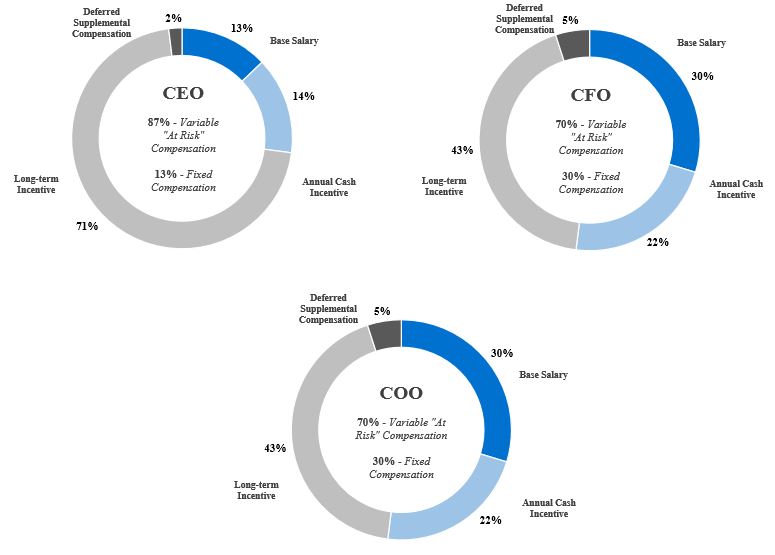
The Compensation Committee typically grants equity-based awards, including time-based restricted stock units and performance-based restricted stock units, to executive officers and other employees on an annual grant cycle in March of each year. The Compensation Committee also makes off cycle awards from time to time on an as-needed basis. The Company does not currently grant stock options or stock appreciation rights. The Company does not take material nonpublic information into account when determining the timing and terms of equity compensation awards, and the Company does not time the disclosure of material non-public information for the purpose of affecting the value of executive compensation.
Oversight of Executive Compensation
Role of the Compensation Committee
The Compensation Committee has oversight responsibility in administering and providing guidance over the Company’s executive compensation programs. The following is a summary of the Compensation Committee’s key responsibilities regarding executive compensation:
•To establish and review the overall compensation philosophy of the Company;
•To review and approve the Company’s corporate goals and objectives relevant to the compensation for the CEO and other executive officers, including annual performance objectives;
•To evaluate the performance of the CEO and other executive officers (in consultation with the CEO) in light of those goals and objectives and, based on such evaluation, approve, or recommend to the full Board the approval of, the annual salary, bonus, long-term incentive compensation, and other benefits for the CEO and other executive officers;
•To oversee the administration of the Company’s stock-based compensation plans;
•To oversee the Company's Clawback Policy (as defined below);
•To review and assess stockholders’ say-on-pay and consider results of the most recent say-on-pay vote in evaluating and determining executive compensation; and
•To review and evaluate the Company's executive succession plan.
The Compensation Committee meets throughout the year to review the performance and compensation of the CEO and other NEOs. The Compensation Committee generally uses a consistent approach to determine the compensation of each NEO by using the same suite of compensation components to maintain alignment amongst the executive team. In addition, the Compensation Committee engages with the Compensation Committee's independent compensation consultant to select an appropriate peer group and obtain market data and compensation analysis on the Company's total executive compensation mix relative to the peer group. In making compensation decisions for the executives as a group, the Compensation Committee sets total compensation, including long-term incentives, based on numerous factors, including Company performance, competitive market pay comparison and individual responsibilities, experience and performance.
Role of Management
To satisfy its responsibilities, the Compensation Committee works with management, including the CEO. The management team assists the Compensation Committee by providing information on current market forecasts, corporate and individual performance, as well as management’s perspective on compensation matters and market compensation data provided by the Compensation Committee's independent compensation consultant.
Annually, the CEO provides the Compensation Committee with an evaluation of his own performance that is based mainly upon the Company’s financial performance and achievement of annual operating plan objectives. The Compensation Committee evaluates the CEO on these and other criteria without the presence of the CEO. The total compensation package for the CEO is determined by the Compensation Committee and approved by the Board, based on the Compensation Committee’s complete evaluation, input from the independent compensation consultant, the CEO's performance, the Company's performance, and competitive industry practices.
In addition, the CEO annually evaluates each of the NEOs and makes compensation recommendations for such NEOs to the Compensation Committee. In developing recommendations, the CEO considers each NEO’s performance against Company goals, and, as applicable, business segment or functional department performance goals and the performance of each NEO relative to key business goals for each applicable year, as further described below. The independent compensation consultant reviews and provides comments to the Compensation Committee on the CEO’s recommendations. The Compensation Committee has discretion in approving, disapproving, or modifying any of the CEO’s recommended salary adjustments, annual bonus targets or proposed equity awards to the other NEOs, subject to final Board approval.
Role of the Independent Compensation Consultant
In determining compensation for 2025, the Compensation Committee retained Aon Human Capital Solutions, a division of Aon plc ("Aon"), an independent national compensation consulting firm, as the Compensation Committee's
independent compensation consultant to advise on executive and director compensation matters. Aon assisted the Compensation Committee in developing a competitive total compensation program that is consistent with the VSE executive compensation program philosophy of goal-oriented pay-for-performance and that allows the Company to attract, retain, and motivate talented executives.
Generally, the Company's compensation consultant provides various services to the Compensation Committee, including the review, analysis, and update of the compensation peer group; the annual review and analysis of the NEO compensation against competitive market data based on the companies in the peer group; the design of the long-term equity incentive program; the annual risk assessment for executive compensation; review and analysis of the non-employee director compensation; and insight into emerging compensation trends. Aon has provided these services to the Compensation Committee since May 2024.
The Compensation Committee reviews the compensation consultant's independence on an annual basis. For 2025, the Compensation Committee determined that there were no conflicts of interest as a result of any current or historical engagement with Aon.
Say-on-Pay Vote of Stockholders
As part of the compensation-setting process, the Compensation Committee considers the results of the stockholder advisory vote to approve the NEO compensation from the prior year.
At the Company's 2025 annual meeting of stockholders, approximately 57.2% of the votes cast were voted in favor of the Say-on-Pay proposal. The Compensation Committee considered these results, together with feedback received through the Company's stockholder engagement efforts as described in the next section.
Stockholder Engagement
In 2025, the Company's longstanding practices of regular engagement with stockholders continued, covering a range of topics including Company strategy, business performance, corporate governance, and other relevant matters. Senior management participated in numerous investor meetings, calls, and conferences. These interactions provided investors with opportunities to meet key executives, ask questions, and share perspectives. Relevant feedback from stockholder outreach efforts is communicated to the Board or appropriate Committees for consideration, helping to ensure that input from stockholders informs decisions and strategic direction. The viewpoints of proxy advisory firms representing the interests of various stockholders are also considered, helping to guide the actions of the Board and Compensation Committee in enhancing the executive compensation program.
In addition, in connection with the Company's Say-on-Pay vote, management conducted extensive stockholder outreach to solicit feedback specifically on the Company's executive compensation practices. Management conducted outreach to stockholders representing approximately 65% of the Company’s outstanding shares. Stockholders representing approximately 46% of the Company’s outstanding shares provided feedback, including many of the Company’s largest institutional investors. Stockholder meetings included participation by one or more of the following individuals: Chief Executive Officer, Chief Financial Officer, Chief Legal Officer, VP of Investor Relations and Compensation Committee Chair.
While the Say-on-Pay proposal received majority support, with 57.2% of votes cast in favor, this level of support was meaningfully lower than in prior years (for example, 83.2% support in 2024). In connection with the vote, the Company engaged with stockholders to better understand the decline in support. Stockholders were generally supportive of the Company and of the work done transitioning the business over the last few years. During these discussions, stockholders were asked for feedback and ideas for improvement. A few stockholders suggested concerns with the use of retroactive adjustments to performance metrics in the 2024 compensation program and the level of specificity disclosed with respect to the performance metrics used in the Company’s short- and long-term incentive programs. These themes were generally consistent with the concerns cited by proxy advisory firms in their voting recommendations. In addition, certain stockholders suggested that the Company consider transitioning certain Stock awards from graded vesting to cliff vesting and to incorporate a metric tied to shareholder value creation such as Total Shareholder Return ("TSR") or Return on Invested Capital ("ROIC") alongside adjusted EBITDA in the Company's incentive programs. The Compensation Committee carefully considered this feedback, and its responses are summarized below.
Retroactive Metric Adjustments and Disclosure
In direct response to stockholder feedback, the Compensation Committee did not modify or adjust 2025 performance goals after they had been initially established. Going forward, absent extraordinary circumstances, the Compensation Committee intends to limit any adjustments to those expressly defined or contemplated at the time performance goals are established, reinforcing the integrity and objectivity of the incentive framework.
In this Proxy Statement, the Company provides enhanced transparency by disclosing the specific quantitative performance goals and the corresponding levels of achievement that determined 2025 incentive compensation payouts. The Company expects to maintain this level of disclosure in future proxy statements.
The Board of Directors and the Compensation Committee believe these actions strengthen governance practices, enhance transparency, and further align executive compensation outcomes directly with measurable performance results and stockholder value creation.
Stock Award Vesting Structure
With respect to the vesting structure of Stock awards, certain stockholders suggested that the Company consider transitioning such Stock awards from ratable vesting to cliff vesting. The Compensation Committee carefully considered this feedback and determined that the Company’s current ratable vesting structure continues to support executive retention and leadership continuity. The Compensation Committee also considered the implications of an immediate shift to cliff vesting, including potential disruption to retention dynamics and increased compensation volatility. These transition risks would likely need to be counterbalanced by including a catch-up feature. At this time, the Compensation Committee believes maintaining the current vesting approach is in the best interests of stockholders and will continue to monitor market practices and stockholder feedback.
TSR or ROIC as a Performance Metric
The Committee believes that adjusted EBITDA remains the most appropriate primary metric at this stage of the Company’s transformation, as it is a key measure used by investors and market participants to evaluate the Company and its peer group and reflects operating performance during a period of significant portfolio repositioning and integration activity. At the same time, the Committee recognizes the importance of capital efficiency, disciplined investment, and cash flow and is actively evaluating if and when there is appropriate timing and structure for incorporating a TSR or ROIC-based metric in the future, in addition to the adjusted EBITDA metric. The Compensation Committee expects that, over time, the incentive framework may evolve to include a balanced set of profitability and return-based measures aligned with long-term stockholder value creation.
Compensation Practices Related to Risk Management
The Company's compensation programs are designed to be balanced and strategically focused on long-term value creation. This structure helps ensure that the highest levels of compensation are achievable only through consistent, superior performance over sustained periods. Additionally, certain compensation components are deferred or become realizable only after vesting periods, promoting long-term management and discouraging excessive short-term risk-taking. The targeted compensation mix is purposefully balanced among current cash payments, deferred cash payments, and equity awards.
Stock Ownership Guidelines further mitigate risk by requiring NEOs to maintain meaningful stock ownership, aligning executive interests with stockholders’ objectives for long-term value enhancement.
The Compensation Committee conducts regular reviews of the relationship between the Company's risk management policies and practices and the incentive compensation provided to NEOs. This helps ensure that compensation incentives promote prudent risk-taking while discouraging unnecessary and excessive risks. The Compensation Committee also examines the alignment between risk management policies, corporate strategy, and senior executive compensation.
Management conducts an annual assessment of the Company's overall compensation structure and presents its findings to the Compensation Committee. This evaluation considers factors such as the overall mix of compensation, performance metrics used in incentive programs, vesting periods, and the relationship between compensation programs and business risk. In March 2025, management reported the results of its evaluation to the Compensation Committee. Based on this assessment, the Compensation Committee concluded that the Company’s compensation policies and practices do not create risks reasonably likely to have a material adverse effect on the Company.
Peer Group and Competitive Market Analysis
Each year, the Compensation Committee, in consultation with management and supported by its independent compensation consultant, reviews and approves a peer group to provide relevant market context for executive compensation decisions. The Compensation Committee does not use a formulaic approach to set NEO compensation at a specific level or percentile relative to this peer group. However, peer group compensation data is periodically reviewed to evaluate the competitiveness of executive compensation practices, structures, and levels.
For 2025 compensation decisions, the Compensation Committee utilized a peer group recommended by Aon in mid-2024. Aon's review considered the impact of the Company's Federal and Defense business divestiture, the Company's increased revenue and market capitalization, and the growing contribution of revenue and earnings from the Company's Aviation segment.
2025 Compensation Peer Group Adjustments
Aon recommended the following adjustments to the 2025 Compensation Peer Group:
Removal of:
• Heritage-Crystal Clean, Inc. (acquired and de-listed)
• Kaman Corporation (acquired and de-listed)
Addition of:
• Albany International Corp.
• FTAI Aviation Ltd.
• Woodward, Inc.
These additions were selected for their alignment with industry focus and size criteria. Aon advised that the revised peer group appropriately aligns with the Company’s industry positioning, size, and total shareholder return performance relative to peer companies. Based on the 2025 Compensation Peer Group, the Company’s revenue and market capitalization are positioned at approximately the 37th and 32nd percentiles, respectively, relative to the peer group, reflecting that the Company’s size is generally consistent with the selected peers.
Based on this review, the Compensation Committee approved the recommended adjustments, resulting in the 2025 Compensation Peer Group.
2026 Compensation Peer Group Adjustments
Aon recommended the following adjustments to the 2026 Compensation Peer Group:
Removal of:
•Air Transport Services Group, Inc.
•Barnes Group Inc.
•Dorman Products, Inc.
•H&E Equipment Services, Inc.
•ICF International, Inc.
•Motorcar Parts of America, Inc.
•Standard Motor Products, Inc.
•Stoneridge, Inc.
•Triumph Group, Inc.
These companies were removed either due to pending or completed acquisitions, the divestiture of the Company’s Fleet segment, or due to lower market capitalization and/or total shareholder return performance.
Addition of:
•AeroVironment, Inc.
•Kratos Defense & Security Solutions, Inc.
•Leonardo DRS, Inc.
•Loar Holdings Inc.
•Moog Inc.
•MSC Industrial Direct Co., Inc.
These companies were added to better represent the Company’s increased focus in the aerospace sector and size, as well as strong 1-year or 3-year total shareholder return performance. The Compensation Committee determined that the revised peer group was consistent with the Company’s operational markets.
The following chart includes the Company's 2025 and 2026 Compensation Peer Groups:
| | | | | | | | | | | | | | |
| Peer Company | | 2025 Compensation
Peer Group (1) | | 2026 Compensation
Peer Group (2) |
| AAR Corp. | | ü | | ü |
| AerSale Corporation | | ü | | ü |
| Astronics Corporation | | ü | | ü |
| Dorman Products, Inc. | | ü | | |
| Ducommun Incorporated | | ü | | ü |
| H&E Equipment Services, Inc. | | ü | | |
| ICF International, Inc. | | ü | | |
| Motorcar Parts of America, Inc. | | ü | | |
| Standard Motor Products, Inc. | | ü | | |
| Stoneridge, Inc. | | ü | | |
| Air Transport Services Group, Inc. | | ü | | |
| Barnes Group Inc. | | ü | | |
| Hexcel Corporation | | ü | | ü |
| Triumph Group, Inc. | | ü | | |
| Albany International Corp. | | ü | | ü |
| FTAI Aviation Ltd. | | ü | | ü |
| Woodward, Inc. | | ü | | ü |
| AeroVironment, Inc. | | | | ü |
| Kratos Defense & Security Solutions, Inc. | | | | ü |
| Leonardo DRS, Inc. | | | | ü |
| Loar Holdings Inc. | | | | ü |
| Moog Inc. | | | | ü |
| MSC Industrial Direct Co., Inc. | | | | ü |
(1) For the 2025 Compensation Peer Group, based on Aon's recommendation, the Company removed Heritage-Crystal Clean, Inc. and Kaman Corporation because they were no longer public companies, and added Albany International Corp., FTAI Aviation Ltd. and Woodward, Inc. as new members of the peer group because they met the industry focus (aviation), market and size criteria, and had strong one-year and three-year TSR performance.
(2) For the 2026 Compensation Peer Group, based on Aon's recommendation, the Company removed Air Transport Services Group, Inc., Barnes Group Inc., Dorman Products, Inc., H&E Equipment Services, Inc., ICF International, Inc., Motorcar Parts of America, Inc., Standard Motor Products, Inc., Stoneridge, Inc., and Triumph Group, Inc. because of pending or completed acquisitions, industry focus, or due to market performance. The Company added AeroVironment, Inc., Kratos Defense & Security Solutions, Inc., Leonardo DRS, Inc., Loar Holdings Inc., Moog Inc., and MSC Industrial Direct Co., Inc. to better reflect the Company’s aerospace focus, size, and strong recent shareholder returns.
2025 Components of Executive Compensation
The three key elements of the Company's executive compensation program are base salary, annual cash incentive awards, and long-term incentives. The long-term incentives include time and performance equity-based incentive awards and deferred supplemental compensation. The following sets forth the program design and, where applicable, metrics and 2025 payouts with respect to each component of the 2025 NEO compensation program.
Base Salary
Base salary is the principal “fixed” cash element of executive compensation. The Company's compensation program supports competitive base salaries as a necessary element of overall compensation to attract and retain highly qualified executive officers. The Compensation Committee also believes that it is important that each NEO receives a market-competitive base salary as compared to like executives in the peer group.
In addition, while the compensation for the executive team is weighted towards long-term equity compensation, the need to broadly align salaries with the peer group and other public industry competitors is recognized. The initial base salary of each NEO was established at hire date. The Compensation Committee reviews base salaries on an annual basis and may adjust them from time to time, with a goal of providing competitive, fixed cash compensation to the executive officers. The Compensation Committee generally references base salaries at or slightly above the median for comparable positions in the peer group when making base salary determinations.
For 2025, based on the 2025 Compensation Peer Group data and the recommendation of Aon, the Compensation Committee approved increases to the base salaries of Messrs. Cuomo and Thomas. As discussed above, in July 2024, the Compensation Committee approved an updated compensation peer group to better reflect the Company's transformed business following the divestiture of its Federal and Defense segment. As part of this review, the Compensation Committee considered updated market analyses for executive roles. The Compensation Committee determined that Mr. Cuomo's base salary and total direct compensation were positioned below market levels relative to the revised peer group. Due to the Company's strong performance in 2024, the Compensation Committee approved an 11.1% increase to Mr. Cuomo's base salary.
In connection with Mr. Thomas’ appointment to the expanded role of Chief Operating Officer, the Compensation Committee reviewed competitive compensation data for similarly situated executive roles, including benchmark data from the 2025 Compensation Peer Group and survey data from the Radford McLagan Compensation Database. In its evaluation, the Compensation Committee considered the addition of full profit and loss responsibility across the Aviation segment, oversight of newly acquired business integration activities, and enterprise-wide Information Technology leadership.
Following this review, the Compensation Committee approved a 22.2% increase to Mr. Thomas’ base salary to position his compensation more appropriately relative to the competitive market range for comparable chief operating officer roles. The Compensation Committee determined that such changes in executive base salary would allow the Company to be market competitive, provide for incentives that are intended to attract, retain and motivate the current executive officers and help align executive and shareholder value creation over the medium and long term.
The 2025 base salaries for the NEOs (which were effective as of January 1, 2025), as compared to their year-end 2024 base salaries, are set forth below:
| | | | | | | | | | | |
| Name | 2024 Base Salary Rate | 2025 Base Salary Rate | Percentage Increase |
| John A. Cuomo | $900,000 | $1,000,000 | 11.1% |
| Adam R. Cohn | $550,000 | $550,000 | —% |
| Benjamin Thomas | $450,000 | $550,000 | 22.2% |
Annual Incentive Award
NEOs are eligible to earn an annual cash incentive designed to reward and promote the achievement of the Company’s short-term annual business objectives while enhancing stockholder value. The 2025 annual incentive award program (the “AIP”) was based primarily on achieving certain annual financial results established by the Compensation Committee and approved by the Board at the beginning of the year. The Compensation Committee maintains discretion on AIP allocation for all participating NEOs.
The key financial performance metrics for the AIP were: revenue, adjusted EBITDA, and adjusted free cash flow. The Compensation Committee selected revenue, adjusted EBITDA, and adjusted free cash flow because they are key financial and operational metrics that measure the Company performance as aligned with current market conditions, peer group comparison and shareholder value creation. The performance metrics for the AIP also include an individual component for each participating NEO, which was based on key business goals and performance as well as contribution to the management team’s execution of the overall operating and strategic plan for the Company, in each case as subjectively evaluated by the Compensation Committee in its discretion. The participating NEOs' key business goals under the AIP program included the following: (i) progress towards the integration of the Turbine Controls and Kellstrom businesses and related systems, with targeted completion of approximately 75% during 2025; (ii) implementation of the OEM Solutions licensed program, with targeted completion of approximately 90% during 2025; (iii) execution of the sale and separation of the Company’s Fleet segment and restructuring of the organization and operating model following the divestiture, including alignment under a “One VSE” structure; (iv) retention of key employees and development of internal talent to support succession planning and long-term leadership continuity; and (v) organic pipeline development to support the Company’s long-term growth strategy, including progress toward a $2 billion revenue objective.
For purposes of the AIP, adjusted EBITDA represents net income before interest expense, income taxes, amortization of intangible assets and depreciation and other amortization adjusted for discrete items such as acquisition, integration, divestiture and restructuring costs (primarily related to the acquisition of Turbine Weld and Aero 3, and the Fleet divestiture) and stock-based compensation. For purposes of the AIP, adjusted free cash flow means cash provided from operating activities less capital expenditures adjusted for the after-tax impact of items identified as part of the Company’s reported adjusted EBITDA. Each of the metrics is measured on a consolidated basis for the Company. In establishing the goals for each metric, the Compensation Committee considered how achievement of the performance goals could be impacted by events expected to occur in the future, and how likely it would be for the goals to be achieved. The target goals were established at levels that were appropriately challenging to attain, aligned with market and customer conditions, and required considerable effort on the part of each NEO to achieve. Achievement of above-target goals (where applicable) is considered to be a “stretch” target given market conditions.
The weightings utilized for each metric are detailed below.
The AIP for Messrs. Cuomo, Cohn, and Thomas consisted of four weighted elements as illustrated in the table below:
| | | | | | | | | | | | | | |
| Executive | Revenue | Adjusted EBITDA | Adjusted Free Cash Flow | Individual Business Goals |
| John A. Cuomo | 30% | 40% | 20% | 10% |
| Adam R. Cohn |
| Benjamin E. Thomas |
For 2025, the Compensation Committee approved changes to the weighting of the annual cash incentive performance metrics to place greater emphasis on profitability while reducing emphasis on revenue, consistent with investor focus areas. Performance against each financial performance metric was assessed relative to threshold target, and maximum performance levels, with payouts prorated on a straight-line basis between levels.
Target 2025 Annual Incentive Award
After reviewing the 2025 Compensation Peer Group data and in consultation with Aon, the Compensation Committee set the target bonus percentages and amounts for each participating NEO for the AIP. To receive a payout under the
AIP, a participating NEO must be an employee during the fiscal year that the bonus payment is earned and at the time when the bonus payment is made.
The participating NEOs’ threshold, target, and maximum opportunities under the AIP awards (expressed as dollar amounts and as percentages of base salary) were as follows:
| | | | | | | | | | | | | | | | | | | | | | | | | | | | | | | | |
| | | Threshold | | Target | | Maximum |
| Name | 2025 Base Salary | | (%) of Base Salary | ($) | | (%) of Base Salary | ($) | | (%) of Base Salary | ($) |
| John A. Cuomo | $1,000,000 | | 55% | $550,000 | | 110% | $1,100,000 | | 220% | $2,200,000 |
| Adam R. Cohn | $550,000 | | 37.5% | $206,250 | | 75% | $412,500 | | 150% | $825,000 |
| Benjamin Thomas | $550,000 | | 37.5% | $206,250 | | 75% | $412,500 | | 150% | $825,000 |
For 2025, based on the 2025 Compensation Peer Group data and the recommendation of Aon, Mr. Cuomo's AIP target opportunity was increased from 100% of base salary to 110% of base salary, and Mr. Thomas’ AIP target opportunity was increased from 60% of base salary to 75% of base salary based on the pay study for his increased responsibilities as COO. Mr. Cohn's AIP target opportunity (as a percentage of base salary) remained the same as in 2025.
With respect to each financial performance metric under the AIP awards, goals are set such that at target 100% of the portion of the award related to such metric would be earned, with a threshold below which 0% of such portion would be earned and at which 50% of such portion would be earned, and with a maximum at or above which 200% of such portion would be earned, with the actual payout earned determined based on where actual performance falls between those levels based on linear interpolation.
Performance Targets - Financial Metrics
The Compensation Committee established threshold, target, and maximum performance levels for each financial metric in connection with its approval of the Company’s 2025 executive incentive compensation. In establishing the 2025 targets, the Compensation Committee defined the scope of the applicable financial metrics to exclude the Fleet segment and stock-based compensation expense (consistent with the current definition of adjusted EBITDA) and to include the Turbine Weld acquisition, to ensure that incentive targets reflected the Company’s current business portfolio and operating structure. The Compensation Committee excluded any financial impact of Aero 3 which was acquired on December 23, 2025 due to the limited period of ownership.
Threshold and maximum performance levels were set relative to target performance to reflect an appropriate range of performance outcomes. Specifically:
•Revenue: threshold performance of 15% below target and maximum performance of 10% above target
•Adjusted EBITDA: threshold performance of 15% below target and maximum performance of 10% above target
•Adjusted Free Cash Flow: threshold performance of $20 million below target and maximum performance of $20 million above target.
Individual Key Business Goals
For the individual business goal portion of the AIP, the Compensation Committee evaluated the contributions and performance of individual participating NEOs relative to the 2025 key business objectives described above. In addition, the Compensation Committee, with input from the CEO, evaluated the achievement level for each continuing NEO based on individual accomplishments, achievements of annual operating plans, and total shareholder returns during 2025.
The subjective component of the AIP was determined following an evaluation of the Company’s annual operating plan objectives, which are designed to support both annual and long-term financial performance, as well as execution of the Company’s growth and transformation strategy.
In 2025, the executive team made substantial progress in advancing the Company’s multi-year transformation into a focused aviation aftermarket business. Key priorities included the integration of newly acquired businesses, realization of acquisition-related synergies, and implementation of strategic OEM and licensed programs designed to
drive incremental revenue and earnings. The Company also successfully executed the sale and business separation of the Fleet segment and completed a comprehensive organizational realignment following the divestiture, aligning the enterprise under a unified “One VSE” operating model.
Significant accomplishments during the year included meaningful progress on the integration of Turbine Controls and Kellstrom, substantial advancement of the OEM Solutions licensed program implementation, and the successful execution of a follow-on equity offering to strengthen the Company’s capital position and support future growth initiatives. In parallel, management implemented targeted employee retention and internal talent development initiatives to enhance succession planning, leadership continuity, and operational stability, while building a robust organic pipeline to support a long-term revenue trajectory toward $2 billion.
As a result of these strategic actions and overall strong operational and financial performance, the Company delivered total shareholder returns in 2025 that exceeded applicable industry benchmarks. In recognition of these accomplishments, the Compensation Committee determined that maximum achievement was warranted for the individual evaluations of Mr. Cuomo, Mr. Cohn, and Mr. Thomas.
Following its review of the achievement of the financial metrics and individual business goals, the Compensation Committee recommended, and the Board approved, the AIP award payouts for the NEOs. The table below sets forth the actual performance level with respect to each of the AIP financial metrics as approved by the Compensation Committee.
| | | | | | | | | | | | | | | | | | | | |
| Performance Metric | Weighting | Threshold
($ millions) | Target
($ millions) | Max
($ millions) | Actual Results
($ millions, if applicable) | Payout Percentage |
| Revenue | 30% | $906 | $1,066 | $1,173 | $1,109 | 140% |
| Adjusted EBITDA | 40% | $132 | $155 | $171 | $181 | 200% |
| Adjusted Free Cash Flow | 20% | $(40) | $(20) | $0 | $15 | 200% |
| Individual Business Goals | 10% | N/A | N/A | N/A | Max | 200% |
| Total Weighted Payout Percentage | 182% |
2025 AIP Payouts
As described above, the Compensation Committee determined that the maximum performance level had been achieved with respect to each continuing NEO’s individual business goals. As a result, each continuing NEO earned a total AIP payout equal to 182% of target.
As a result of the achievement levels with respect to the AIP metrics described above, the Compensation Committee recommended, and the Board approved, the following AIP payouts for each NEO:
| | | | | | | | | | | | | | | | | |
| Executive | 2025 Base Salary | Target ($) | Total Actual AIP Payout | Actual as a % of Target | Actual as a % of Salary |
| John A. Cuomo | $1,000,000 | $1,100,000 | $2,002,000 | 182% | 200% |
| Adam R. Cohn | $550,000 | $412,500 | $750,750 | 182% | 137% |
| Benjamin Thomas | $550,000 | $412,500 | $750,750 | 182% | 137% |
Long-term Incentive Award
Each year, NEOs are generally granted long-term incentive awards in the form of equity and cash-based awards. The two components of the Company’s 2025 long-term incentive program are the LTI Program (as defined below) and the Deferred Supplemental Compensation Plan (“DSC Plan”). The Compensation Committee determines the amount of these awards, as well as the mix or weighting of these awards.
Long-term Incentive Equity Program
In 2025, NEOs were generally eligible to receive restricted stock units, consisting of both service-based restricted stock units ("RSUs") that vest over a three-year vesting period and performance-based RSUs ("PRSUs") that are earned based on performance over three individual performance years during a three-year performance period. The RSU and PRSU awards comprise the current long-term incentive equity program for the NEOs (the “LTI Program”). Time and service-based RSUs provide a retention incentive, and PRSUs both provide a retention incentive and align compensation to financial performance. For 2025 PRSU awards, performance is earned and aligned based on an adjusted EBITDA metric.
The following illustrates VSE’s 2025 LTI Program structure:
| | | | | | | | | | | | | | | | | |
| | | TIME-BASED | | |
| | | Restricted Stock Units (RSUs) 160% of Base Salary for CEO 58% of Base Salary for CFO 58% of Base Salary for COO | | RETENTION Fixed number of RSUs that vest ratably over three years |
| | | |
| | | |
| LONG-TERM EQUITY INCENTIVE AWARDS | | | |
| | | | |
| | PERFORMANCE-BASED (1) | | |
| | Performance-based Restricted Stock Units (PRSUs) 240% of Base Salary for CEO 87% of Base Salary for CFO 87% of Base Salary for COO | | PERFORMANCE/GROWTH Conditional number of shares payable based on adjusted EBITDA; one-third eligible to vest during each year of the three-year performance period |
| | | |
| | | |
| | | |
| | | | | |
When considering the total long-term equity-based incentive award amount granted to each participating NEO, the Compensation Committee reviews the comparison to the peer group, the relative value of each compensation element, VSE’s recent performance, the expense of such awards, and the impact on dilution.
Time-based RSUs. The Compensation Committee grants time-based RSUs to assist in retaining NEOs and increase equity ownership, which further aligns NEOs’ interests with those of stockholders. The following table sets forth the time-based RSUs that were granted to the participating NEOs in February of 2025. The units generally vest in three equal installments in February 2026, 2027, and 2028, subject to continuous employment.
| | | | | | | | | | | | | | |
| Executive | Base Salary | Target % of Salary | Target RSU
Award Value | # of RSUs Granted |
| John A. Cuomo | $1,000,000 | 160% | $1,600,000 | 13,502 |
Adam R. Cohn | $550,000 | 58% | $319,000 | 2,692 |
| Benjamin Thomas | $550,000 | 58% | $319,000 | 2,692 |
For 2025, following a review of competitive market data from the Company’s 2025 Compensation Peer Group and in consultation with its independent compensation consultant, Aon, the Compensation Committee approved increases to the target value of time-based RSU awards for Mr. Cuomo (from 120% to 160% of base salary) and Mr. Thomas (from 50% to 58% of base salary). These adjustments were designed to better position target long-term incentive opportunities relative to market levels. In approving Mr. Thomas’ increase, the Committee also considered his expanded role as Chief Operating Officer. The Compensation Committee determined that this alignment would allow the Company to be market competitive, provide for awards that are intended to attract, retain, and motivate the current executive officers and align executive and shareholder wealth creation over the long term.
The Compensation Committee maintained Mr. Cohn’s total long-term incentive opportunity for 2025 at the same level as the prior year. Consistent with the Company’s standard guideline that long-term incentive equity be delivered 60% in PRSUs and 40% in RSUs, the Compensation Committee adjusted the allocation of Mr. Cohn’s equity awards resulting in a decrease in the target value of RSUs from 60% of base salary to 58% of base salary and a corresponding
increase in PRSU target value. This adjustment reflected a correction to the prior year’s allocation, which did not align with the Company’s guideline, and did not change Mr. Cohn’s overall long-term incentive opportunity.
In connection with entering into an amended employment agreement in December 2024, Mr. Cuomo received a special grant of time-based RSUs on January 1, 2025, valued at approximately $1,500,000, which RSUs generally vest in substantially equal installments on December 31, 2026 and December 31, 2027, subject to continued employment ("Cuomo Special Grant"). The Compensation Committee approved the Cuomo Special Grant following a comprehensive review of competitive market data and in recognition of Mr. Cuomo’s sustained performance and leadership in executing the Company’s strategic priorities. The Compensation Committee determined that Mr. Cuomo’s target total direct compensation was below its intended competitive positioning relative to the Company’s 2024 compensation peer group and approved the grant to better align his compensation with market levels, positioning him at approximately the 76th percentile of peer group compensation.
In approving the Cuomo Special Grant, the Committee also considered the increased scope and complexity of Mr. Cuomo’s responsibilities as the Company continues to grow and scale, as well as the importance of executive continuity and retention in support of the Company’s ongoing strategic initiatives and long-term performance objectives. The award was delivered entirely in long-term equity with multi-year vesting to reinforce alignment with stockholders and sustained long-term value creation.
Performance-based RSUs. PRSUs are equity awards that may be earned based on achievement with respect to pre-established financial goals. PRSUs are subject to a three-year performance period, with one-third of the opportunity eligible to vest based on financial performance during each year of the performance period.
The PRSU program includes a “catch up” opportunity in the second and third years of the performance period based on cumulative performance through the end of each such year. Following the completion of the second year of the performance period, performance from the beginning of the first year through the end of the second year is measured on a cumulative basis. The resulting cumulative performance level (measured against the second-year cumulative targets) determines a cumulative payout percentage. If the cumulative payout percentage exceeds the number of PRSUs previously earned for years one and two of the performance cycle, the excess shares are earned. A similar cumulative measurement is performed at the conclusion of the third year of the performance period.
This structure is designed to promote sustained long-term performance and disciplined decision-making over the full multi-year performance horizon. By measuring cumulative results, the program rewards consistent execution and allows for recovery from short-term volatility, while not eliminating accountability for annual performance. Underperformance in any single year is not automatically offset; rather, payouts reflect total performance achieved relative to cumulative targets.
The Compensation Committee believes this design reduces incentives for short-term actions that could adversely impact long-term value creation, encourages management to pursue strategic investments that may span multiple fiscal years, and aligns realized compensation with sustained operating and financial performance. The number of PRSUs earned for each performance year vests in the first quarter of the subsequent year based on achievement of the performance metrics and continued service. When combined with time-based RSUs that vest over three years, the overall equity structure reinforces retention, long-term alignment with stockholders, and a focus on durable value creation.
Description of 2025 PRSU Awards
The 2025 PRSU award is based on the Company’s adjusted EBITDA performance for the three-year period from 2025 to 2027. For each year of the performance period, an adjusted EBITDA performance metric is set such that at the target 100% of the award would be earned, with a threshold below which 0% of such year’s opportunity would be earned and at which 33% of such year's opportunity would be earned, and with a maximum at or above which 200% of such year’s opportunity would be earned, with the actual number of units earned determined based on where actual performance falls between those levels based on linear interpolation.
2025 PRSU Performance Targets
The Compensation Committee established threshold, target, and maximum adjusted EBITDA performance levels for each year of the three-year performance period in connection with its approval of the 2025 PRSU awards. Threshold
and maximum performance levels were set relative to target performance to reflect an appropriate range of performance outcomes. In establishing the 2025 targets, the Compensation Committee defined the scope of the applicable financial metrics to exclude the Fleet segment and stock-based compensation expense (consistent with the current definition of adjusted EBITDA) and to include the Turbine Weld acquisition, to ensure that incentive targets reflected the Company’s current business portfolio and operating structure. The Compensation Committee excluded any financial impact of Aero 3 which was acquired on December 23, 2025 due to the limited period of ownership.
Performance targets applicable to outstanding PRSU awards granted in prior years that included fiscal 2025 as a performance year were addressed separately, as described below under “Description of Prior Year Awards for 2024 and 2023.” Threshold, target and maximum goal levels for adjusted EBITDA, and related payout percentage, are set forth in the table below, as approved by the Compensation Committee when it established the goals in 2025.
| | | | | | | | | | | | | | | | | |
| Performance Metric | Threshold
($ millions) | Target
($ millions) | Max
($ millions) | Actual Results
($ millions) | Payout Percentage |
| Adjusted EBITDA | $140 | $155 | $171 | $181 | 200% |
2025 PRSU Opportunity
In March 2025, participants were granted PRSUs, with the number of shares ultimately earned ranging from 0% to 200% of the target opportunity based on achievement of the applicable performance goals. The following table sets forth the target PRSU opportunity for each of the NEOs for the 2025-2027 performance period:
| | | | | | | | | | | | | | |
| Executive | Base Salary | Target PRSUs for 2025-2027 |
| Target Award as % of Salary | Target Award Value (Target $ value) | # of Target PRSUs Granted |
| John A. Cuomo | $1,000,000 | 240% | $2,400,000 | 20,253 |
Adam R. Cohn | $550,000 | 87% | $478,500 | 4,038 |
| Benjamin Thomas | $550,000 | 87% | $478,500 | 4,038 |
For 2025, based on the 2025 Compensation Peer Group data and the recommendation of Aon, the NEO's PRSU target opportunities were increased from their respective 2024 PRSU target values as follows: Mr. Cuomo's PRSU target value was increased from 180% of base salary to 240% of base salary and Mr. Thomas' PRSU target value was increased from 72.5% of base salary to 87% of base salary. In approving Mr. Thomas’ increase, the Committee considered his expanded role as Chief Operating Officer. These changes were also intended to continue to align target long-term incentive award values more closely with the 2025 Compensation Peer Group median. The Compensation Committee determined that this alignment would allow the Company to be market competitive, provide for awards that are intended to attract, retain and motivate the current executive officers and help align executive and shareholder wealth creation over the long term.
The Compensation Committee maintained Mr. Cohn’s total long-term incentive opportunity for 2025 at the same level as the prior year. Consistent with the Company’s standard guideline that long-term incentive equity be delivered 60% in PRSUs and 40% in RSUs, the Compensation Committee adjusted the allocation of Mr. Cohn’s equity awards resulting in an increase in the target value of PRSUs from 85% of base salary to 87% of base salary and a corresponding decrease in RSU target value. This adjustment reflected a correction to the prior year’s allocation, which did not align with the Company’s guideline, and did not change Mr. Cohn’s overall long-term incentive opportunity.
Description of Prior Year Awards for 2024 and 2023
The 2024 PRSU award is based on the Company’s adjusted EBITDA performance for the three-year period from 2024 to 2026. For each year of the performance period, an adjusted EBITDA performance metric is set such that at the target 100% of the award would be earned, with a threshold below which 0% of such year’s opportunity would be earned and at which 33% of such year's opportunity would be earned, and with a maximum at or above which 200% of such year’s opportunity would be earned, with the actual number of units earned determined based on where actual performance falls between those levels based on linear interpolation. In establishing the 2025 targets, the
Compensation Committee defined the scope of the applicable financial metrics to exclude the Fleet segment and to include the Turbine Weld acquisition, to ensure that incentive targets reflected the Company’s current business portfolio and operating structure. The Compensation Committee excluded any financial impact of Aero 3 which was acquired on December 23, 2025 due to the limited period of ownership. Threshold, target and maximum goal levels for adjusted EBITDA, and related payout percentage, are set forth in the table below, as approved by the Compensation Committee.
| | | | | | | | | | | | | | | | | |
| Performance Metric | Threshold
($ millions) | Target
($ millions) | Max
($ millions) | Actual Results
($ millions, if applicable) | Payout Percentage |
| Adjusted EBITDA | $123 | $137 | $150 | $168(1) | 200% |
(1) Results differ from those for the 2025 tranche of the 2025 PRSU awards because the adjusted EBITDA measurement established by the Compensation Committee for the 2025 awards excludes stock-based compensation expense.
The 2023 PRSU award is based on the Company’s adjusted EBITDA performance for the three-year period from 2023 to 2025. For each year of the performance period, an adjusted EBITDA performance metric is set such that at the target 100% of the award would be earned, with a threshold below which 0% of such year’s opportunity would be earned and at which 33% of such year's opportunity would be earned, and with a maximum at or above which 200% of such year’s opportunity would be earned, with the actual number of units earned determined based on where actual performance falls between those levels based on linear interpolation. In establishing the 2025 targets, the Compensation Committee defined the scope of the applicable financial metrics to exclude the Fleet segment and to include the Turbine Weld acquisition, to ensure that incentive targets reflected the Company’s current business portfolio and operating structure. The Compensation Committee excluded any financial impact of Aero 3 which was acquired on December 23, 2025 due to the limited period of ownership. Threshold, target and maximum goal levels for adjusted EBITDA, and related payout percentage, are set forth in the table below, as approved by the Compensation Committee.
| | | | | | | | | | | | | | | | | |
| Performance Metric | Threshold
($ millions) | Target
($ millions) | Max
($ millions) | Actual Results
($ millions, if applicable) | Payout Percentage |
| Adjusted EBITDA | $123 | $137 | $150 | $168(1) | 200% |
(1) Results differ from those for the 2025 tranche of the 2025 PRSU awards because the adjusted EBITDA measurement established by the Compensation Committee for the 2025 awards excludes stock-based compensation expense.
The 2024 and 2023 PRSU awards include the same "catch-up" feature that is applicable to the 2025 PRSU awards. This structure is designed to promote sustained long-term performance and disciplined decision-making over the full multi-year performance horizon.
PRSU Payouts for 2025 Performance Year
2025-2027 PRSU Award Payouts for 2025 Performance Year
In early 2026, the Compensation Committee recommended, and the Board approved, PRSU payouts at 200% for the 2025 performance year under the 2025-2027 PRSU awards, based on 2025 adjusted EBITDA performance of $181 million, excluding Aero 3 results.
The following table details the number of PRSUs earned under the 2025-2027 PRSU awards for the 2025 performance year that vest in March of 2025 for the NEOs:
| | | | | | | | | | | |
| Executive | Maximum Potential 2025-2027 PRSUs Vesting in 2026 | | Actual 2025-2027 PRSUs Vesting in 2026 |
| (# of Shares) | | (# of Shares) |
| John A. Cuomo | 13,502 | | 13,502 |
| Adam R. Cohn | 2,692 | | 2,692 |
| Benjamin Thomas | 2,692 | | 2,692 |
2024-2026 PRSU Award Payouts for 2025 Performance Year
In early 2026, the Compensation Committee recommended, and the Board approved, the PRSU payouts at 200% for the 2025 performance year under the 2024-2026 PRSU awards, based on 2025 adjusted EBITDA performance of $168 million, including stock-based compensation expense and excluding Aero 3 results.
The following table details the number of PRSUs earned under the 2024-2026 PRSU awards for the 2024 performance year that vest in March of 2026:
| | | | | | | | | | | |
| Executive | Maximum Potential 2024-2026 PRSUs Vesting in 2026 | | Actual 2024-2026 PRSUs Vesting in 2026 |
| (# of Shares) | | (# of Shares) |
| John A. Cuomo | 14,289 | | 14,289 |
| Adam R. Cohn | 3,795 | | 3,795 |
| Benjamin Thomas | 2,879 | | 2,879 |
The amounts in the table above include (i) the portion of the 2025 tranche of the award that was eligible to vest based on 2025 performance and (ii) the portion of 2024 tranche of the award that was not earned for 2024 performance but was eligible to vest based on cumulative performance over the 2024-2025 period under the “catch-up” feature of the award.
2023-2025 PRSU Award Payouts for 2025 Performance Year
In early 2026, the Compensation Committee recommended, and the Board approved, the PRSU payouts at 200% for the 2025 performance year under the 2023-2025 PRSU awards, based on 2025 adjusted EBITDA performance of $168 million, including stock-based compensation expense and excluding Aero 3 results.
The following table details the number of PRSUs earned under the 2023-2025 PRSU awards for the 2025 performance year that generally vest in March of 2026:
| | | | | | | | | | | |
Executive | Maximum Potential 2023-2025 PRSUs Vesting in 2026 | | Actual 2023-2025 PRSUs Vesting in 2026 |
| (# of Shares) | | (# of Shares) |
John A. Cuomo | 20,081 | | 20,081 |
| Adam R. Cohn (1) | — | | — |
Benjamin Thomas | 3,640 | | 3,640 |
(1) Mr. Cohn did not receive any PRSU awards for 2023 because he was not employed by the Company during 2023.
Deferred Supplemental Compensation Plan
VSE has a non-qualified Deferred Supplemental Compensation Plan (“DSC Plan”) for certain VSE officers, including some NEOs and other key management representatives. The objective of the DSC Plan is to compensate executives for their contribution to VSE’s profitability and drive long-term executive retention. The DSC Plan provides, at the Board’s discretion, for an incentive pool to be created through an annual contribution to the plan subject to two
requirements: (1) that the annual funding of the plan not exceed 12% of VSE’s consolidated net income for the year, and (2) that a DSC award not exceed 15% of the participant’s annual salary. Each participant’s potential allocation from the annual contribution bears the same percentage of the annual contribution as that participant’s salary bears to the total annual participant salaries.
Benefits are payable to participants on retirement or resignation, subject to the vesting schedule described below, and other plan provisions, or on a change of control of VSE as described below. In general, a NEO’s account under the DSC Plan vests based on the NEO’s years of service with the Company, as follows:
| | | | | | | | |
| Years of Service | | Percent Vest |
| 0 to 2 | | 0% |
| 3 | | 50% |
| 5 | | 100% |
The DSC Plan pool for 2025 is approximately $378,000 which equals 15.0% of the cumulative salaries of the 2025 DSC Plan participants. The following illustrates the actual allocation received by the NEOs in 2025:
| | | | | | | | | | | |
| | 2025 DSC Plan Allocation |
| | (Outcomes) |
| Executive | Base Salary | % of Salary | Award Value |
| John A. Cuomo | $1,000,000 | 15.0% | $150,000 |
| Adam R. Cohn | $550,000 | 15.0% | $82,500 |
| Benjamin Thomas | $550,000 | 15.0% | $82,500 |
Other Compensation
In addition to the elements of total direct compensation described above, the executive compensation program includes other elements of compensation that are designed primarily to attract, motivate, and retain executives critical to the Company's long-term success and to provide a competitive compensation structure. VSE executive officers, including the NEOs, are eligible to participate in the VSE Employee 401(k) Plan, which is an Internal Revenue Service qualified plan available to all eligible employees. During 2025, VSE paid a 401(k) matching contribution equal to 100% of the employee deferral on the first 3% of the employee pay deferred and 50% of the employee deferral on the next 2% of the employee pay deferred, with all such contributions fully vested when made. Specific amounts contributed to the VSE 401(k) Plan on behalf of the NEOs are included in the “2025 Summary Compensation Table” under the heading “All Other Compensation” set forth below.
The Company offers an employee stock purchase plan to employees (including the NEOs) that generally allows participants to purchase Stock at a discount. This plan further enhances the alignment between the interests of employees (including NEOs) with those of stockholders.
As described in the “All Other Compensation” section under Executive Compensation, Mr. Cuomo received relocation benefits in connection with the Company’s decision to relocate its corporate headquarters from Alexandria, Virginia to Miramar, Florida. In light of this strategic corporate relocation, Virginia ceased to be Mr. Cuomo’s primary state of residence.
The relocation benefit was provided as a fixed cash amount to facilitate the transition and to offset costs associated with establishing a primary residence in the new headquarters location. The Compensation Committee approved the benefit to support leadership continuity and ensure Mr. Cuomo’s full-time presence in the Company’s new principal executive offices following the relocation. The Compensation Committee determined that providing relocation support in connection with the headquarters move was appropriate and consistent with market practice for executive relocations resulting from a corporate decision. No ongoing housing or relocation allowances were provided beyond this fixed relocation benefit.
Employment Agreements and Severance Arrangements
During 2025, the Company was a party to employment agreements with each of the NEOs. These agreements provide for severance benefits that are payable upon a termination without “cause” or for “good reason,” either prior to or in connection with a change in control of the Company. In general, the severance provisions under these agreements are designed to promote the stability and continuity of senior management. The actual severance benefits set forth in the employment agreements were determined based on the Compensation Committee’s judgment and advice received by the Compensation Committee from its independent compensation consultant. Information regarding the key terms of these agreements is summarized in the “Executive Compensation” section below under the caption “Potential Payments Upon Termination or Change in Control.”
Stock Ownership Guidelines
The Compensation Committee believes that meaningful stock ownership by executive officers is important in aligning management’s interests with the interests of stockholders. All of the NEOs are in compliance with the stock ownership guidelines or within their five-year initial period to achieve such guidelines. Stock ownership guidelines are implemented to require continuing NEOs to maintain consistent ownership of Stock based on a multiple of the executive’s annual base salary as set forth below:
| | | | | | | | |
| Name | | Ownership Requirement |
| John A. Cuomo | | 5x base salary |
Adam R. Cohn | | 3x base salary |
| Benjamin Thomas | | 3x base salary |
Clawback Policy
In 2023, the Company adopted a new Compensation Clawback Policy (the “Clawback Policy”), which complies with both the new rules promulgated by the Nasdaq Stock Market and SEC requirements and standards. The Clawback Policy provides for the prompt recovery (or clawback) of certain excess incentive-based compensation received during an applicable three-year recovery period by current or former executive officers in the event the Company is required to prepare an accounting restatement due to material noncompliance with any financial reporting requirement under the securities laws. Triggering events include accounting restatements to correct an error in previously issued financial statements that is material to such previously issued financial statements, or that would result in a material misstatement if the error were corrected in the current period or left uncorrected in the current period. Excess incentive-based compensation for these purposes generally means the amount of incentive-based compensation received (on or after October 2, 2023) by such executive officer that exceeds the amount of incentive-based compensation that would have been received by such executive officer had it been determined based on the restated amounts, without regard to any taxes paid. Incentive-based compensation potentially subject to recovery under the Clawback Policy is in general limited to any compensation granted, earned or vested based wholly or in part on the attainment of one or more financial reporting measures.
In general, a broad range of recoupment methods may be utilized under the Clawback Policy. The Clawback Policy does not condition clawback on the fault of the executive officer, but clawback is not required in limited circumstances where the Compensation Committee determines that recovery would be impracticable and (1) recovery attempts have already been made, but the direct expenses paid to a third party to enforce the Clawback Policy would exceed the amount to be recovered, (2) the recovery of amounts would violate applicable home country law, or (3) the recovery would cause the non-compliance of a tax-qualified retirement plan under the Internal Revenue Code and applicable regulations. The operation of the Clawback Policy is subject to a brief phase-in process during the first few years after its effectiveness. Indemnification of any executive officer against the loss of such recovered compensation is not permitted.
Hedging and Pledging Policy
VSE policies prohibit any director, officer or participant in VSE’s long-term incentive plan to engage in any transaction in which they may profit from short-term speculative swings in the value of VSE’s securities or pledge VSE Stock in lending transactions. Accordingly, Company policy prohibits these individuals from engaging in transactions designed
to hedge or offset any decrease in the market value of Stock that they own, including, among other things, the purchase or sale of put and call options, short sales and pledging VSE’s securities as collateral.
Accounting Considerations
The Company accounts for stock-based compensation in accordance with ASC Topic 718 - Compensation - Stock Compensation ("ASC Topic 718"). In accordance with ASC Topic 718, the grant date fair value of stock awards is computed based on the estimated fair value of the awards on the grant date, or with respect to performance-based awards, the service inception date if earlier, using various assumptions. These amounts are calculated for accounting purposes and are reported in the compensation tables. The amounts reported do not necessarily correspond to the actual value that will ultimately be realized by the named executive officers, which will depend on the Company's stock price at the time of vesting or exercise and the extent to which the applicable vesting conditions are satisfied.
COMPENSATION AND HUMAN RESOURCES COMMITTEE REPORT
The Compensation Committee has reviewed the preceding Compensation Discussion and Analysis and discussed its contents with VSE management. Based on the review and discussions, the Compensation Committee has recommended to the Board that this Compensation Discussion and Analysis be included in the Proxy Statement and, through incorporation by reference, in the Company's Annual Report on Form 10-K for the year ended December 31, 2025.
| | | | | |
Compensation Committee: | John E. Potter, Chair |
| Anita D. Britt |
| Edward P. Dolanski |
| Lloyd E. Johnson |
EXECUTIVE COMPENSATION
2025 Summary Compensation Table
The table below summarizes the total compensation of each of the NEOs in each of the last three fiscal years, as applicable.
| | | | | | | | | | | | | | | | | | | | | | | | | | | | | |
Name and Principal Position ________________ (a) |
Year _____ (b) |
Salary ($) ________ (c) |
Bonus ($) ________ (d) |
Stock Awards ($)(1) _________ (e) |
Option Awards ($) ______ (f) |
Non-Equity Incentive Plan Compensation ($)(2) _____________ (g) | Change in Pension Value and Non-Qualified Deferred Compensation Earnings
($)
_____________
(h) |
All Other Compensation ($)(3) _____________ (i) |
Total ($) __________ (j) |
John A. Cuomo
CEO and President | 2025 | 1,000,000 | — | 5,499,980 | — | 2,002,000 | — | 463,662 | 8,965,642 |
| 2024 | 900,000 | — | 2,699,987 | — | 1,197,000 | — | 148,413 | 4,945,400 |
| 2023 | 848,000 | — | 2,120,021 | — | 1,458,560 | — | 136,880 | 4,563,461 |
Adam R. Cohn Chief Financial Officer (4) | 2025 | 550,000 | — | 797,505 | — | 750,750 | — | 96,500 | 2,194,755 |
| 2024 | 183,333 | 200,000 | 2,797,495 | — | 182,875 | — | 32,577 | 3,396,280 |
| | | | | | | | |
Benjamin E. Thomas
Chief Operating Officer | 2025 | 550,000 | — | 797,505 | — | 750,750 | — | 96,500 | 2,194,755 |
| 2024 | 450,000 | — | 551,270 | — | 388,800 | — | 80,932 | 1,471,002 |
| 2023 | 368,880 | — | 396,556 | — | 361,502 | — | 68,100 | 1,195,038 |
Notes to 2025 Summary Compensation Table
1.The amounts reported in column (e) for 2025 represent stock awards granted under the 2006 Plan. The amounts in this column reflect the aggregate grant date fair values of RSU and PRSU awards computed in accordance with FASB ASC Topic 718. The amounts with respect to PRSU awards reflect the values at the grant date based on the probable outcome of the applicable performance conditions. Such values are determined based on the target award amounts. The assumptions used to value these awards can be found in Note 10 to the financial statements included in the Company's Annual Report on Form 10-K for the fiscal year ended December 31, 2025. Assuming maximum achievement with respect to the applicable performance goals for PRSU awards, the amount reported in this column would be as follows: $7,899,960 for Mr. Cuomo and $1,276,008 for Mr. Cohn and for Mr. Thomas.
2.The amounts reported in column (g) for 2025 represent amounts earned by the NEOs under the AIP, discussed above under “Compensation Discussion and Analysis—2025 Components of Executive Compensation—Annual Incentive Award.”
3.The amounts reported in column (i) include 401(k) plan matching contributions allocated to each NEO's account for 2025 pursuant to the VSE Employee 401(k) Plan discussed above under “Compensation Discussion and Analysis—2025 Components of Executive Compensation—Other Compensation” (Mr. Cuomo - $13,662; Mr. Cohn - $14,000; and Mr. Thomas - $14,000). Also included in column (i) is the amount allocated to each NEO's account for 2025 under the DSC Plan. See discussion above under “Compensation Discussion and Analysis—2025 Components of Executive Compensation—Deferred Supplemental Compensation Plan” (Mr. Cuomo - $150,000; Mr. Cohn - $82,500; and Mr. Thomas - $82,500). For Mr. Cuomo, column (i) also includes relocation costs of $300,000.
4.Mr. Cohn became VSE's Chief Financial Officer on September 3, 2024. No information is provided for Mr. Cohn for 2023 because Mr. Cohn was not employed at the Company during such year.
2025 Grants of Plan-Based Awards Table
The table below reports all grants of plan-based awards to each of the NEOs for the year ended December 31, 2025.
| | | | | | | | | | | | | | | | | | | | | | | | | | | | | | | | | | | |
Name ________ (a) |
Award Type ________
|
Grant Date ________ (b) | Estimated Possible Payouts Under Non-Equity Incentive Plan Awards (1) |
Estimated Future Payouts Under Equity Incentive Plan Awards (2) |
All Other Stock Awards; Number of Shares of Stock or Units (#/$)(3) ________ (i) | | |
Grant Date Fair Value of Stock and Option Awards ($)(4) _________ (l) |
Threshold ($) _________ (c) |
Target ($) _________ (d) |
Maximum ($) _________ (e) |
Threshold (#) _________ (f) |
Target (#) _________ (g) |
Maximum (#) _________ (h) |
| John A. Cuomo | PRSU | 2/28/25 | — | — | — | 6,683 | 20,253 | 40,506 | — | | | | 2,399,981 |
| RSU | 1/1/25 | — | — | — | — | — | — | 15,773 | | | | 1,500,012 |
| RSU | 2/28/25 | | | | | | | 13,502 | | | | 1,599,987 |
| AIP | | 550,000 | 1,100,000 | 2,200,000 | — | — | — | — | | | | — |
Adam R. Cohn | PRSU | 2/28/25 | — | — | — | 1,333 | 4,038 | 8,076 | — | | | | 478,503 |
| RSU | 2/28/25 | — | — | — | — | — | — | 2,692 | | | | 319,002 |
| AIP | | 206,250 | 412,500 | 825,000 | — | — | — | — | | | | — |
| Benjamin E. Thomas | PRSU | 2/28/25 | — | — | — | 1,333 | 4,038 | 8,076 | — | | | | 478,503 |
| RSU | 2/28/25 | — | — | — | — | — | — | 2,692 | | | | 319,002 |
| AIP | | 206,250 | 412,500 | 825,000 | — | — | — | — | | | | — |
Notes to Grants of Plan-Based Awards Table
1.The amounts reported in these columns represent possible payouts to the NEOs under the AIP, as further described above under “Compensation Discussion and Analysis—2025 Components of Executive Compensation—Annual Incentive Award."
2.The amounts in these columns relate to PRSUs which are subject to performance goals. The PRSUs are subject to a three-year performance period, with one-third of the opportunity eligible to vest based on adjusted EBITDA performance during each year of the performance period, and a potential “catch-up” number of PRSUs eligible to vest following the second and third years of the performance period. Any amount earned with respect to an applicable performance year generally vests in March of the immediately following year. If the performance measurement for an applicable year or period falls below the “Threshold” level of attainment, achievement will be 0% for such year or period. If the performance falls at or above the "Maximum" for an applicable year or period, the achievement will be 200% of target for such year or period for all the NEOs. For any results between threshold and target or target and maximum the percentage earned will be determined based on straight-line interpolation from such measurements. For further information regarding the terms of these awards, see “Compensation Discussion and Analysis—2025 Components of Executive Compensation—Long-Term Incentive Awards.”
3.Amounts in this column represent the number of RSUs that were awarded during fiscal 2025, which generally vest in substantially equal installments in February 2026, 2027, and 2028. However, the January 1, 2025 award of 15,773 RSUs to Mr. Cuomo generally vests in substantially equal installments in December 2026 and 2027.
4.Amounts represent the grant date fair value of stock awards granted in 2025, computed in accordance with FASB ASC Topic 718. For PRSUs, the value represents the value at the grant date based on the probable outcome of the performance conditions.
Narrative to Summary Compensation Table and Grants of Plan-Based Awards Table
See “Compensation Discussion and Analysis” above for a description of the AIP and the 2025 RSU and PRSU awards pursuant to which the amounts listed in the “2025 Grants of Plan-Based Awards” table were paid or awarded and the criteria for such payments and awards. For information regarding individual agreements with the NEOs, see the section below titled “Potential Payments Upon Termination or Change in Control.”
Outstanding Equity Awards at 2025 Fiscal Year End Table
The table below reports all outstanding equity awards for each of the NEOs as of December 31, 2025.
| | | | | | | | | | | | | | | | | |
| | Stock awards |
Name _______________________ (a) |
Grant Date ________
|
Number of Shares or Units of Stock That Have Not Vested (#) ______________ (g) | Market Value of Shares or Units of Stock That Have Not Vested ($)(1) ______________ (h) |
Equity Incentive Plan Awards: Number of Unearned Shares, Units or Other Rights That Have Not Vested (#) ______________ (i) |
Equity Incentive Plan Awards: Market or Payout Value of Unearned Shares, Units or Other Rights That Have Not Vested ($)(1)
______________
(j) |
| John A. Cuomo | 2/28/25 | 13,502(2) | 2,332,741 | | 27,004(3) | 4,665,481 | |
| 2/28/25 | 13,502(4) | 2,332,741 | | — | | — | |
| 1/01/25 | 15,773(5) | 2,725,101 | | — | | — | |
| 3/08/24 | 14,289(6) | 2,468,711 | | 14,077(7) | 2,432,083 | |
| 3/08/24 | 9,385(8) | 1,621,446 | | — | | — | |
| 3/10/23 | 20,081(10) | 3,469,394 | | — | | — | |
| 3/10/23 | 6,694(11) | 1,156,522 | | — | | — | |
Adam R. Cohn | 2/28/25 | 2,692(2) | 465,097 | | 5,384(3) | 930,194 | |
| 2/28/25 | 2,692(4) | 465,097 | | — | | — | |
| 9/11/24 | 3,795(6) | 655,662 | | 3,739(7) | 645,987 | |
| 9/11/24 | 2,640(8) | 456,113 | | — | | — | |
| 9/11/24 | 17,994(9) | 3,108,823 | | — | | — | |
| Benjamin E. Thomas | 2/28/25 | 2,692(2) | 465,097 | | 5,384(3) | 930,194 | |
| 2/28/25 | 2,692(4) | 465,097 | | — | | — | |
| 3/08/24 | 2,879(6) | 497,405 | | 2,835(7) | 489,803 | |
| 3/08/24 | 1,956(8) | 337,938 | | — | | — | |
| 3/10/23 | 3,640(10) | 628,883 | | — | | — | |
| 3/10/23 | 1,311(11) | 226,501 | | — | | — | |
| | | | | |
| | | | | |
Notes to Outstanding Equity Awards Table
1.For the 2025, 2024 and 2023 RSU and PRSU awards, the amounts shown are based on the closing price of the Stock on December 31, 2025, of $172.77.
2.This amount reflects the portion of the 2025-2027 PRSU award that was earned based on achievement of the applicable performance goals for the 2025 performance year and will generally vest on February 28, 2026.
3.These amounts reflect the portion of 2025 PRSU awards that can be earned based on the achievement of adjusted EBITDA performance as of the end of the 2026 and 2027 performance years (the remainder of the amount reported for each NEO). The amount actually earned with respect to each such performance year will generally vest on February 28 of the immediately following fiscal year. Amounts reported reflect the maximum number of shares that may be earned under the awards for the remainder of the performance period. For more information regarding the terms of these awards, see “Compensation Discussion and Analysis—2025 Components of Executive Compensation—Long-Term Incentive Awards.”
4.These amounts represent RSU awards granted in 2025 that generally vest in substantially equal installments on February 28, 2026, February 28, 2027, and February 28, 2028.
5.This amount represents an RSU award granted in 2025 that generally vests in substantially equal installments on December 31, 2026 and December 31, 2027.
6.This amount reflects the portion of the 2024-2026 PRSU award that was earned based on achievement of the applicable performance goals for the 2025 performance year and will generally vest on March 8, 2026.
7.These amounts reflect the portion of 2024 PRSU awards that can be earned based on the achievement of adjusted EBITDA performance as of the end of the 2026 performance year (the remainder of the amount reported for each NEO). Amounts reported reflect the maximum number of shares that may be earned under the awards for the remainder of the performance period. The amount actually earned will generally vest on March 8 of the immediately following fiscal year. For more information regarding the terms of these awards, see “Compensation Discussion and Analysis—2025 Components of Executive Compensation—Long-Term Incentive Awards.”
8.These amounts represent an RSU award granted in 2024 that generally vests (or vested) in substantially equal installments on March 8, 2025, March 8, 2026, and March 8, 2027.
9.This amount represents an RSU award granted in 2024 that vests as to 25% of the award on September 11, 2025 and September 11, 2026, and 50% on September 11, 2027.
10.These amounts reflect the portion of the 2023-2025 PRSU award that was earned based on the achievement of the applicable performance goals for the 2025 performance year and will generally vest on March 10, 2026. For more information regarding the terms of these awards, see “Compensation Discussion and Analysis—2025 Components of Executive Compensation—Long-Term Incentive Awards.”
11.These amounts represent RSU awards granted in 2023 that generally vest (or vested) in substantially equal installments on March 10 of 2024, 2025, and 2026.
2025 Option Exercises and Stock Vested
The following table reports stock awards vested for the NEOs during the fiscal year ended December 31, 2025.
| | | | | | | | | | | | | |
| | | Stock Awards |
Name ____________________________________________________ (a) | | | | Number of Shares Acquired on Vesting
(#) (1)
_______________________
(d) | Value Realized on Vesting
($)
___________________
(e) |
| John A. Cuomo | | | | 58,881 | | 6,759,444 | |
Adam R. Cohn | | | | 10,999 | | 1,577,148 | |
| Benjamin E. Thomas | | | | 11,264 | | 1,292,924 | |
Notes to Option Exercises and Stock Vested Table
1.The number of shares acquired pursuant to the 2006 Plan on vesting reported in column (d) includes shares withheld for the minimum amount of taxes required to be withheld by the Company under applicable law, as follows: Mr. Cuomo, 23,169 shares; Mr. Cohn, 4,061 shares; and Mr. Thomas, 2,743 shares. The value realized on vesting reported in column (e) represents the number of vested shares acquired valued at the closing market price for Stock on the vesting date, including the shares withheld for the minimum amount of taxes required to be withheld by the Company under applicable law.
2025 Pension Benefits
VSE does not provide defined benefit pension arrangements or post-retirement health coverage for executives or other employees.
2025 Non-Qualified Deferred Compensation
The following table provides information related to potential benefits payable to each NEO under VSE’s DSC Plan as of and for the year ended December 31, 2025.
| | | | | | | | | | | | | | | | | | | | |
Name (1)
________________ (a) |
Plan
_____________
|
Executive Contributions in Last FY ($) ____________ (b) |
VSE Contributions in Last FY (2) ($) ___________ (c) |
Aggregate Earnings in Last FY (2) (3) ($) ____________ (d) | Aggregate Withdrawals/ Distributions ($) ___________ (e) |
Aggregate Balance at Last FYE (4) ($) ____________ (f) |
| John A. Cuomo | DSC Plan | — | 150,000 | 203,409 | — | 1,918,826 |
Adam R. Cohn | DSC Plan | — | 82,500 | 913 | — | 110,913 |
| Benjamin E. Thomas | DSC Plan | — | 82,500 | 47,882 | — | 426,560 |
Notes to Non-Qualified Deferred Compensation Table
1.Mr. Cuomo and Mr. Thomas have been participants for approximately 7 years and Mr. Cohn became a participant during 2024.
2.Amounts reported in column (c) are reported in the 2025 Summary Compensation Table in the “All Other Compensation” column and represent contributions made by VSE to the DSC Plan following the 2025 calendar year. Aggregate earnings reported in column (d) are not reported in the 2025 Summary Compensation Table.
3.Amounts reported in column (d) represent the earnings during the calendar year 2025 for amounts held in the DSC Plan for each NEO.
4.Amounts reported in column (f) for the DSC Plan include aggregate contributions that were reported as compensation to the NEOs in Summary Compensation Tables for previous years and aggregate earnings that were not reported as compensation. Aggregate contributions to the DSC Plan previously reported in the Summary Compensation Tables for the years 2008 through 2025, the period for which plan records identifying contributions to individual participants are
available, and aggregate earnings (losses) for the same period are set forth below. Aggregate contributions represent total amounts contributed into the DSC Plan by VSE and, where applicable, by each NEO. Aggregate earnings represent the earnings or losses on amounts held in the DSC Plan for each NEO since the NEO became eligible to participate in the DSC Plan.
| | | | | | | | | | | | | | |
| Name | | Aggregate
Contributions ($) | | Aggregate
Earnings ($) |
| John A. Cuomo | | 1,377,754 | | | 541,072 | |
Adam R. Cohn | | 110,000 | | | 913 | |
| Benjamin E. Thomas | | 323,481 | | | 103,079 | |
Narrative to Non-Qualified Deferred Compensation Table
The DSC Plan is a non-qualified, noncontributory plan that was originally adopted by the Board in 1994. The DSC Plan provides, at the Board’s discretion, for an annual contribution to the plan not to exceed 12% of VSE's consolidated net income for the year. Each officer’s allocation from the annual contribution bears the same percentage to the annual contribution as that officer’s salary bears to total annual participant salaries. For 2025 an annual contribution of 15% of salary ($378,000) for the executive management team was authorized and allocated to four participant accounts, including a total of approximately $315,000 allocated to the NEOs’ accounts.
Benefits under the DSC Plan are payable to the participant on retirement or resignation, subject to a vesting schedule, non-competition agreement, and other plan provisions, or if a change of control of VSE occurs. The Company's contributions to the DSC Plan are irrevocable and are used to pay benefits under the plan, subject to the claims of the Company's general creditors.
VSE's annual contribution to the DSC Plan is deposited in a plan trust. The aggregate annual contribution is allocated for the benefit of each of the participants and credited to each of their respective employer contribution accounts. Participants make investment elections for their respective account balances and annual contributions from a group of life insurance (COLI) investment funds managed by Lincoln Financial Group. For more information regarding the terms of the DSC Plan, see above under “Executive Compensation Components-Long-Term Incentive Compensation.”
Potential Payments Upon Termination or Change in Control
The following table sets forth potential payments to the NEOs on termination of employment or a change in control of VSE. The amounts shown assume that such termination and (as applicable) change in control was effective as of December 31, 2025 and that the share price at the time of termination was the closing price of Stock on December 31, 2025 ($172.77), and are estimates of the amounts that would be paid to the NEOs on the applicable event. The actual amounts to be paid can only be determined at the time of the applicable triggering event.
Potential Payments Upon Termination or Change in Control Table (1)
| | | | | | | | | | | | | | | | | | | | | | | | | | |
| Name | | Benefit | |
Termination
Without
Cause ($) | |
Termination
on Change
of Control ($) | | Death/Disability ($) |
| John A. Cuomo | | Cash Severance | | 6,300,000 | | | 6,300,000 | | | 2,000,000 | |
| | DSC Plan | | 1,918,826 | | | 1,918,826 | | | 1,918,826 | |
| | Equity Awards | | 2,725,101 | | | 15,501,961 | | | 2,725,101 | |
Adam R. Cohn | | Cash Severance | | 1,443,750 | | | 1,925,000 | | | 550,000 | |
| | DSC Plan | | 110,913 | | | 110,913 | | | 110,913 | |
| | Equity Awards | | 3,108,823 | | | 5,373,665 | | | 3,108,823 | |
| Benjamin E. Thomas | | Cash Severance | | 825,000 | | | 1,237,500 | | | — | |
| | DSC Plan | | 426,560 | | | 426,560 | | | 426,560 | |
| | Equity Awards | | — | | | 2,531,599 | | | — | |
1.The table excludes information with respect to contracts, agreements, plans, or arrangements to the extent they do not discriminate in scope, terms, or operation in favor of executive officers and that are available generally to all salaried employees (for example, qualified benefit plan distributions and payment for unused vacation pay). For information regarding the amounts set forth in this table, see the narrative discussion below.
Narrative to Potential Payments Upon Termination or Change in Control Table
Employment Agreements with Continuing Named Executive Officers
During 2025, the Company was party to employment agreements with each of its NEOs. The key terms of these employment agreements (which include customary confidentiality, non-competition, non-solicitation, and non-disparagement restrictive covenants) are summarized in the table below:
| | | | | | | | | | | |
| Key Terms | Mr. Cuomo | Mr. Cohn | Mr. Thomas |
| Initial Agreement Term (1) | January 1, 2025 – January 1, 2028 | September 3, 2024 - September 3, 2026 | January 1, 2022 – January 1, 2024 |
| Minimum Base Salary | $1,000,000 | $550,000 | $348,000 |
| Annual Cash Incentive | Participates with target of at least 110% of base salary | Participates with target of at least 75% of base salary | Participates |
| Long-Term Incentive | Participates with target annual award opportunity of at least 400% of base salary | Participates | Participates |
| Other Benefits | Participation in employee benefit plans (including DSC Plan) and other customary fringe benefits (“Other Benefits”) | Other Benefits | Other Benefits |
1.At the end of the initial term of each agreement and on each anniversary thereafter, unless VSE gives the executive 60 days written notice (or 150 days for Mr. Cuomo) that the term will not be extended, the term will be extended for an additional year. Accordingly, Mr. Thomas' employment agreement term was automatically extended for two additional one-year periods on the applicable anniversary.
Under the terms of an NEO's employment agreement, each NEO is entitled to certain payments and benefits in the event of certain termination circumstances. These payments and benefits are summarized below. In general, payment of these amounts is contingent upon the NEO’s execution and non-revocation of a release of claims in favor of VSE.
| | | | | |
Qualifying Termination (1) with no Change in Control (2) | Qualifying Termination During Change in Control Period (3) |
For Mr. Cuomo and Mr. Cohn —a lump sum in cash equal to 1.5 times (or, for Mr. Cuomo, three times) the sum of his annual base salary and target annual cash incentive award (without regard to any reduction thereto) | For Mr. Cuomo and Mr. Cohn—a lump sum in cash equal to two times (or, for Mr. Cuomo, three times) the sum of annual base salary and target annual cash incentive (without regard to any reduction thereto) |
For Mr. Thomas —a lump sum in cash equal to 1.5 times the executive’s annual base salary (without regard to any reduction thereto) | For Mr. Thomas — a lump sum in cash equal to (A) 1.5 times annual base salary (without regard to any reduction thereto) plus (B) one times target annual cash incentive (without regard to any reduction thereto) |
| | | | | |
For All NEOs—a lump sum in cash equal to the executive’s accrued but unvested benefits under the DSC Plan | For All NEOs—a lump sum in cash equal to the executive’s accrued but unvested benefits under the DSC Plan
|
For Mr. Cuomo and Mr. Cohn — full vesting of the Cuomo Special Grant and the Cohn Special Grant (4), respectively | For All NEOs—outstanding and unvested time-based and performance-based restricted stock, RSUs or similar rights to acquire capital stock of VSE will vest in full (with performance-based awards vesting at target) |
1.“Qualifying Termination” is the termination of the executive’s employment by VSE other than due to “Cause” (as defined in the employment agreements), death or disability (including by providing notice that the employment term will not be extended), or by the executive for “Good Reason” (as defined in the employment agreements).
2.“Change in Control” has the meaning assigned to such term in the employment agreements.
3.The “Change in Control Period” is the period within two years after a Change in Control, or, for Mr. Cuomo and Mr. Cohn only, within six months before a Change in Control.
4.Mr. Cohn was entitled to a special grant (granted on September 11, 2024) of time-based RSUs valued at approximately $2,000,000, which award generally vests as to 25% of the award on each of the first two anniversaries of the grant date and as to the remainder on the third anniversary of the grant date (the “Cohn Special Grant”). Mr. Cuomo was entitled to the Cuomo Special Grant (granted on January 1, 2025), which consisted of time-based RSUs valued at approximately $1,500,000, which RSUs generally vest in substantially equal installments on December 31, 2026 and December 31, 2027.
Under Mr. Cuomo’s employment agreement, VSE may elect to continue making payments to him equivalent to his annual base salary for a period of time equivalent to the period of certain of his non-competition covenants under the employment agreement in other termination scenarios.
Each employment agreement includes a “best net” provision, which generally provides that if certain severance payments are subject to excise tax under Section 280G of the Internal Revenue Code, the payments will be reduced to the greatest amount that could be paid without giving rise to such excise tax, unless the executive would be in a better after-tax position after receiving all payments and paying any applicable excise tax.
In the event of a termination of employment due to death or disability, Mr. Cuomo and Mr. Cohn’s employment agreements, as applicable, provide for the following benefits: (1) lump sum cash amount equal to the executive’s annual base salary (or, for Mr. Cuomo, two times his annual base salary); and (2) automatic vesting in full of the Cuomo Special Grant or the Cohn Special Grant, as applicable.
Pay Ratio Disclosure
The following information about the relationship between the median of the annual total compensation of all of VSE's employees and those of VSE's consolidated subsidiaries other than the CEO and the annual total compensation of Mr. Cuomo, VSE's CEO and President (and Principal Executive Officer or “PEO”), is provided in compliance with the requirements of Item 402(u) of Regulation S-K of the Exchange Act. Due to the permitted use of reasonable estimates and assumptions in preparing this pay ratio disclosure, the disclosure may involve a degree of imprecision, and thus the Company views this pay ratio disclosure as a reasonable estimate. The Company believes its compensation philosophy and process yield an equitable result and is presenting such information for 2025 in accordance with the required disclosure as follows:
| | | | | |
| Median Employee 2025 annual total compensation | $64,408 |
| Mr. Cuomo (“PEO”) 2025 annual total compensation | 8,965,642 |
| Ratio of PEO to Median Employee annual total compensation | 139.2 to 1 |
For purposes of this pay ratio disclosure, 2025 PEO annual total compensation represents the total compensation reported for Mr. Cuomo under the “2025 Summary Compensation Table.” To determine the 2025 annual total compensation of VSE's median employee, the Company identified and calculated the elements of that employee’s compensation for 2025 in accordance with the requirements of Item 402(c)(2)(x) of Regulation S-K.
In determining the median employee, a listing was prepared of all full time and part time employees (other than the PEO) of the Company and the Company's consolidated subsidiaries as of December 31, 2025. However, for purposes of determining the median employee, and in accordance with SEC rules, the Company excluded 288 employees who became employees as a result of the acquisition of Aero 3 that was completed in December 2025. Wages and salaries for 2025 (the Company's consistently applied compensation measure) were based on compensation paid and the median employee was determined based on that list. As of December 31, 2025, the Company employed approximately 1,601 persons (but as noted above, the Company excluded 288 of such employees from the median employee determination for 2025). Additionally, the Company employs a diverse range of employees, many of whom live and work in lower cost of living areas other than Miramar, Florida.
Pay Versus Performance
The following table, and the disclosure that follows, provides information regarding the compensation of the Company's principal executive officer (“PEO”) and the average compensation of other named executive officers (“non-PEO NEOs”) as reported in the Summary Compensation Table for the past five fiscal years, their “compensation actually paid” as calculated pursuant to SEC rules, and certain performance measures.
| | | | | | | | | | | | | | | | | | | | | | | | | | |
| | | | | Value of Initial Fixed $100 Investment Based On: | | |
Year |
Summary Compensa-tion Table Total for PEO ($) (1) |
Compensa-tion actually Paid to PEO ($) (1) (2) |
Average Summary Compensa-tion Table Total for Non-PEO NEOs ($) (1) |
Average Compensa-tion Actually Paid to Non-PEO NEOs ($)(1) (2) |
Total Shareholder Return (3) | Peer Group Total Shareholder Return (4) |
Net Income ($) (5) |
Adjusted EBITDA ($ in millions) (6) |
| (a) | (b) | (c) | (d) | (e) | (f) | (g) | (h) | (i) |
| 2025 | 8,965,642 | | 21,713,709 | | 2,194,755 | | 5,223,007 | | 463.81 | | 230.45 | | 11,703,000 | | 181 | |
| 2024 | 4,945,400 | | 10,531,618 | | 1,393,162 | | 1,476,009 | | 254.49 | | 162.31 | | 15,324,000 | | 136 | |
| 2023 | 4,563,461 | | 8,141,517 | | 1,291,531 | | 2,081,656 | | 172.03 | | 141.88 | | 39,134,000 | | 114 | |
| 2022 | 3,623,791 | | 3,175,331 | | 1,085,086 | | 895,314 | | 123.89 | | 132.89 | | 28,059,000 | | 92 | |
| 2021 | 2,348,503 | | 3,085,979 | | 970,465 | | 1,000,181 | | 159.54 | | 113.22 | | 7,966,000 | | 73 | |
1.Mr. Cuomo was VSE's PEO for the full year for each of fiscal years 2025, 2024, 2023, 2022 and 2021. For fiscal year 2025, the non-PEO NEOs were Messrs. Cohn and Thomas. For fiscal year 2024, the non-PEO NEOs were Messrs. Cohn, Tarang Sharma, Stephen D. Griffin, Chad M. Wheeler, and Thomas and Ms. Farinaz S. Tehrani. For fiscal year 2023, the non-PEO NEOs were Messrs. Griffin, Wheeler, and Thomas and Ms. Tehrani. For fiscal year 2022, the non-PEO NEOs were Messrs. Griffin, Wheeler, Thomas and Robert A. Moore and Ms. Tehrani. For fiscal year 2021, the non-PEO NEOs were Messrs. Griffin, Wheeler, Thomas, Moore and Thomas M. Kiernan. Messrs. Sharma, Griffin, Wheeler, Moore, and Kiernan, and Ms. Tehrani are former employees of the Company.
2.For each of fiscal years 2025, 2024, 2023, 2022 and 2021 (each, a “Covered Year”), in determining both the compensation “actually paid” to VSE's PEO and the average compensation “actually paid” to the non-PEO NEOs for purposes of this Pay Versus Performance table (“PVP Table”), the Company deducted from or added back to the total amounts of compensation reported in column (b) or column (d), as applicable, for such Covered Year certain amounts in accordance with SEC rules. For fiscal year 2025, such amounts are set forth in the following tables:
| | | | | | | | | | | |
| Item and Value Added (Deducted) | | 2025 |
| For Mr. Cuomo: | | |
| - change in actuarial present value of pension benefits | | $ | — | |
| + service cost of pension benefits | | $ | — | |
| + prior service cost of pension benefits | | $ | — | |
| - Summary Compensation Table “Stock Awards” column value | | $ | (5,499,980) | |
| - Summary Compensation Table “Option Awards” column value | | $ | — | |
| + Covered Year-end fair value of outstanding equity awards granted in Covered Year | | $ | 12,056,063 | |
| | | | | | | | | | | |
| +/- change in fair value (from prior year-end to Covered Year-end) of equity awards outstanding at Covered Year-end that were granted in prior years | | $ | 5,032,129 | |
| + vesting date fair value of equity awards granted and vested in Covered Year | | $ | — | |
| +/- change in fair value (from prior year-end to vest date in Covered Year) of prior-year equity awards vested in Covered Year | | $ | 1,159,855 | |
| -prior year-end fair value of prior-year equity awards forfeited in Covered Year | | $ | — | |
| +includable dividends/earnings paid or accrued on equity awards during Covered Year | | $ | — | |
| | | | | | | | | | | |
| Item and Value Added (Deducted) | | 2025 |
| For Non-PEO NEOs (Average): | | |
| - change in actuarial present value of pension benefits | | $ | — | |
| + service cost of pension benefits | | $ | — | |
| + prior service cost of pension benefits | | $ | — | |
| - Summary Compensation Table “Stock Awards” column value | | $ | (797,505) | |
| - Summary Compensation Table “Option Awards” column value | | |
| + Covered Year-end fair value of outstanding equity awards granted in Covered Year | | $ | 1,860,387 | |
| +/- change in fair value (from prior year-end to Covered Year-end) of equity awards outstanding at Covered Year-end that were granted in prior years | | $ | 1,588,960 | |
| + vesting date fair value of equity awards granted and vested in Covered Year | | $ | — | |
| +/- change in fair value (from prior year-end to vest date in Covered Year) of prior-year equity awards vested in Covered Year | | $ | 376,410 | |
| - prior year-end fair value of prior-year equity awards forfeited in Covered Year | | $ | — | |
| + includable dividends/earnings paid or accrued on equity awards during Covered Year | | $ | — | |
3.For each Covered Year, VSE's total shareholder return was calculated as the yearly percentage change in the cumulative total shareholder return on VSE's common stock, par value $0.05 per share, measured as the quotient of (a) the sum of (i) the cumulative amount of dividends for a period beginning with the closing price on The Nasdaq Global Select Market on December 31, 2020 through and including the last day of the Covered Year (each one-year, two-year, three-year, four-year and five-year period, the “Measurement Period”), assuming dividend reinvestment, plus (ii) the difference between the closing stock price at the end versus the beginning of the Measurement Period, divided by (b) the closing share price at the beginning of the Measurement Period. Each of these yearly percentage changes was then applied to a deemed fixed investment of $100 at the beginning of each Measurement Period to produce the Covered Year-end values of such investment as of the end of 2025, 2024, 2023, 2022 and 2021 as applicable. Because Covered Years are presented in the table in reverse chronological order (from top to bottom), the table should be read from bottom to top for purposes of understanding cumulative returns over time. The Company total shareholder return reflected in this column has been updated slightly from amounts disclosed in prior years to use a rounding convention consistent with that used in the performance graph in the Company’s Annual Report on Form 10-K for the fiscal year ended December 31, 2025.
4.For purposes of this pay versus performance disclosure, VSE's peer group total shareholder return is calculated based on the S&P 500 Aerospace & Defense Index (the "Index"). For each Covered Year, the Index cumulative total shareholder return was calculated based on a deemed fixed investment of $100 in the Index through each Measurement Period.
5.Net income is calculated in accordance with U.S. Generally Accepted Accounting Principles. The net income reported in this table for 2022 has been corrected from the amount reported for such year in the Pay Versus Performance table in VSE's 2023 proxy statement ($28,063,000).
6.For purposes of this PVP Table, VSE's adjusted EBITDA was calculated as net income before interest expense, income taxes, amortization of intangible assets and depreciation and other amortization adjusted for discrete items such as acquisition, integration, divestiture and restructuring costs, stock-based compensation and other non-recurring expenses, as further described in the Compensation Discussion and Analysis above.
The following charts provide, across the Covered Years, (1) a comparison between VSE's cumulative total shareholder return and the cumulative total shareholder return of the Index, and (2) illustrations of the relationships between (A) the executive compensation actually paid to the PEO and the average of the executive compensation actually paid to the non-PEO NEOs (in each case as set forth in the PVP Table above) and (B) each of the performance measures set forth in columns (f), (h) and (i) of the PVP Table above.
The following table lists the three financial performance measures that the Company believes represent the most important financial performance measures used to link compensation actually paid to the named executive officers for fiscal 2025 to the Company's performance:
| | |
| Revenue |
Adjusted Free Cash Flow |
Adjusted EBITDA |
PROPOSAL 3
APPROVAL, ON A NON-BINDING ADVISORY BASIS, OF THE COMPENSATION OF THE COMPANY’S NAMED EXECUTIVE OFFICERS
| | | | | | | | | | | | | | |
| | | | |
| | What am I voting on? Stockholders are being asked to approve, on a non-binding advisory basis, the compensation of the Company's named executive officers (commonly referred to as "say-on-pay").
Voting Recommendation: FOR the approval, on a non-binding advisory basis, of the compensation of the Company’s named executive officers.
Vote Required: Requires the affirmative vote of a majority of the Stock having voting power present in person or represented by proxy at the Annual Meeting. Because the vote is advisory, it will not be binding upon the Board or the Compensation Committee. The Compensation Committee will, however, carefully consider the outcome of the vote when considering future executive compensation arrangements.
Broker Discretionary Voting Allowed? No, broker non-votes have no effect.
Abstentions: Same effect as a vote against the proposal.
| | |
Section 14A of the Exchange Act requires that the Company include in this 2026 Proxy Statement a non-binding advisory stockholder vote to approve the Company's named executive officers’ compensation as described in this 2026 Proxy Statement (commonly referred to as “say-on-pay”). At the 2021 Annual Meeting, stockholders voted to hold an advisory say-on-pay vote on an annual basis. Based on the Board’s recommendation and the voting results, VSE determined that future say-on-pay votes will be held annually (with the next one expected to occur at the Company's 2027 Annual Meeting of Stockholders) until the next required advisory vote on the frequency of say-on-pay votes, which will also occur at the Company’s 2027 Annual Meeting of Stockholders.
The Company encourages stockholders to review the “Compensation Discussion and Analysis” and the “Executive Compensation” sections of this 2026 Proxy Statement. VSE’s consistent stockholder value creation over the long term is reinforced by and aligned with the executive compensation program. VSE believes the program strikes the appropriate balance between utilizing responsible, measured pay practices and effectively incentivizing the Company's executives to dedicate themselves fully to value creation for its stockholders. This balance is evidenced by the following:
•VSE provides a significant part of executive compensation in performance-based incentives, including annual cash incentive awards and performance-based equity awards. Payouts of performance-based equity awards are generally based on achievement of pre-established financial objectives and are subject to caps on total payouts;
•The earning of performance-based restricted stock unit awards is generally subject to performance over three performance years;
•VSE utilizes multiple performance metrics in its plans and programs to discourage excessive risk-taking. The Company's program design does not encourage excessive focus on a single performance goal to the detriment of other metrics of success; and
•Substantial stock ownership requirements help ensure that the Company's senior executives maintain a significant stake in its long-term success.
The Board strongly endorses the Company’s executive compensation program and recommends that the stockholders vote in favor of the following resolution:
"RESOLVED, that the stockholders approve, on an advisory basis, the compensation of the Company's NEOs as described in this 2026 Proxy Statement under “Compensation Discussion and Analysis” and “Executive Compensation,” including the related tabular and narrative disclosure contained in this 2026 Proxy Statement."
Because the vote is advisory, it will not be binding upon the Board or the Compensation Committee and neither the Board nor the Compensation Committee will be required to take any action as a result of the outcome of the vote on this proposal. The Compensation Committee will, however, carefully consider the outcome of the vote when considering future executive compensation arrangements.
The Board unanimously recommends that stockholders vote “FOR” the approval, on a non-binding advisory basis, of the compensation of the Company’s named executive officers.
PROPOSAL 4
APPROVAL OF AN AMENDMENT TO THE COMPANY’S RESTATED CERTIFICATE OF INCORPORATION TO AUTHORIZE THE ISSUANCE OF BLANK CHECK PREFERRED STOCK
| | | | | | | | | | | | | | |
| | | | |
| | What am I voting on? Stockholders are being asked to approve an amendment to the Company’s Restated Certificate of Incorporation to authorize the issuance of blank check preferred stock.
Voting Recommendation: FOR the approval of an amendment to the Company’s Restated Certificate of Incorporation to authorize the issuance of blank check preferred stock.
Vote Required: Requires the affirmative vote of a majority of the outstanding Stock entitled to vote on the proposal.
Broker Discretionary Voting Allowed? No, broker non-votes have no effect.
Abstentions: Same effect as a vote against the proposal.
| | |
This proposal is to consider and vote upon approving an amendment to the Company’s Restated Certificate of Incorporation to authorize 10,000,000 shares of preferred stock, par value $0.01 per share (the “preferred stock”), which shares will be “blank-check preferred stock,” issuable in one or more series as solely determined by the Board, with voting powers, preferences and relative, participating, optional, or other special powers, preferences or rights and qualifications, limitation, or restrictions thereof as solely determined by the Board (such proposal, the “Charter Amendment Proposal” and such amendment, the “Charter Amendment”). As of the record date, the Company had no preferred stock authorized for issuance.
The Board has approved and recommended for approval by the stockholders the Charter Amendment and the submission of the Charter Amendment Proposal to stockholders for a vote at the Annual Meeting. If the Charter Amendment Proposal is approved by the Company’s stockholders, the Board does not intend to solicit further stockholder approval prior to the issuance of any shares of preferred stock, unless a specific issuance requires stockholder approval under applicable law or under Nasdaq rules or the rules of any quotation system or stock exchange on which the Company’s shares are then listed.
If stockholders approve this Charter Amendment Proposal, we expect to file a Certificate of Amendment to the Restated Certificate of Incorporation of VSE Corporation (the “Certificate of Amendment”) with the Secretary of State of the State of Delaware reflecting the Charter Amendment. Upon the filing of such Certificate of Amendment with the Secretary of State of the State of Delaware, the following changes would be made to the Company’s Restated Certificate of Incorporation:
Article FOURTH of the Company’s Restated Certificate of Incorporation will be amended to read in its entirety as follows:
“FOURTH: The total number of shares of capital stock that the Corporation shall have authority to issue is fifty-four million shares (54,000,000), consisting of forty-four million (44,000,000) shares of common stock, par value $0.05 per share, and ten million (10,000,000) shares of preferred stock, par value $0.01 per share (the “Preferred Stock”).
Preferred Stock. The Preferred Stock may be issued in one or more series. The board of directors is hereby authorized to issue the shares of Preferred Stock in such series and to fix from time to time before issuance the number of shares to be included in any such series and the designation, powers, preferences and relative participating, optional or other rights, if any,
and the qualifications, limitations or restrictions thereof. The authority of the board of directors with respect to each such series will include, without limiting the generality of the foregoing, the determination of any or all of the following:
a.the number of shares of any series and the designation to distinguish the shares of such series from the shares of all other series;
b.the voting powers, if any, and whether such voting powers are full or limited in such series;
c.the redemption provisions, if any, applicable to such series, including the redemption price or prices to be paid;
d.whether dividends, if any, will be cumulative or noncumulative, the dividend rate of such series, and the dates and preferences of dividends on such series;
e.the rights of such series upon the voluntary or involuntary dissolution of, or upon any distribution of the assets of, the Corporation;
f.the provisions, if any, pursuant to which the shares of such series are convertible into, or exchangeable for, shares of any other class or classes or of any other series of the same or any other class or classes of stock, or any other security, of the Corporation or any other corporation or other entity, and the rates or other determinants of conversion or exchange applicable thereto;
g.the right, if any, to subscribe for or to purchase any securities of the Corporation or any other corporation or other entity;
h.the provisions, if any, of a sinking fund applicable to such series; and
i.any other relative, participating, optional, or other special powers, preferences or rights and qualifications, limitations, or restrictions thereof;
all as may be determined from time to time by the board of directors and stated or expressed in the resolution or resolutions providing for the issuance of such Preferred Stock.”
Why the Charter Amendment is Needed
The Board has no current plans, proposals, or arrangements to issue any shares of preferred stock under this authorization. The Board believes, however, that approval of this Charter Amendment Proposal would provide the Company with additional flexibility to take advantage of opportunities as they arise and enhance the Company’s ability to attract investment capital. The ability to establish one or more series of preferred stock with terms determined by the Board would allow the Company to tailor such securities to meet the needs of particular transactions or prevailing market conditions.
The Company expects to fund future capital investments through a combination of equity and debt financing. Under its Restated Certificate of Incorporation, the Company currently is authorized to issue only common stock to meet its equity capital needs. Authorizing preferred stock would provide the Company with additional flexibility by enabling the Board to structure securities that address the Company’s capital needs while responding to market conditions. For example, preferred securities may be structured to provide investors with a fixed preferred return while potentially receiving partial equity treatment from rating agencies. This flexibility could benefit shareholders by allowing the Company to optimize its capital structure through an appropriate mix of common stock, preferred stock and debt, depending on market conditions, the Company’s financing needs and other relevant factors at the time. Preferred stock could also be used in connection with future acquisitions or other strategic transactions.
If this Charter Amendment Proposal is approved, the Board would have the authority, without further stockholder approval (except as may be required by applicable law or the rules of any stock exchange on which the Company’s securities are listed), to issue shares of preferred stock in one or more series and to determine the designations, preferences, rights and limitations of each series, including dividend rights, voting rights, conversion features, redemption provisions and liquidation preferences.
The Company believes it has a strong track record of disciplined capital deployment, including through recent acquisitions. As a result, the Company believes that access to additional capital-raising tools, including preferred stock, could enhance its financial flexibility in support of future growth opportunities. Any decision to issue preferred stock in the future would depend on a variety of factors, including market conditions and the Company’s financing and capital management plans at the time.
Although the Board would have the authority to establish the terms of preferred stock without further stockholder approval, the Board would exercise this authority consistent with its fiduciary duties and in a manner it believes to be in the best interests of the Company and its stockholders.
Certain Disadvantages of the Charter Amendment
If this Charter Amendment Proposal to approve the Charter Amendment is approved, the availability of undesignated blank check preferred stock may have certain negative effects on the rights of holders of VSE common stock. The actual effect of the issuance of any shares of preferred stock upon the rights of holders of VSE common stock cannot be stated until the Board determines the specific rights of the holders of such preferred stock. The Board will be permitted, without future stockholder approval, to issue preferred stock with dividend, liquidation, conversion, or voting or other rights that are superior to and could adversely affect the voting power or other rights of the holders of VSE common stock. Specifically, the Company will be in a position to issue securities that would grant to their holders preferences or priorities over the holders of VSE common stock with respect to, among other things, liquidation, dividends and voting. These preferences or priorities could result in holders of VSE common stock receiving less in the event of a liquidation, dissolution or other winding up of the Company, reduce the amount of funds, if any, available for dividends on VSE common stock, and dilute the voting power of the holders of VSE common stock. The holders of the Company’s preferred stock may also be entitled to vote, and such votes may dilute the voting rights of the holders of VSE common stock when the Company seeks to take corporate action. A series of preferred stock also may be convertible into shares of VSE common stock, which may also dilute the voting power and economic interest of holders of VSE common stock. In addition, in the absence of a proportionate increase in the Company’s earnings and book value, an increase in the aggregate number of outstanding shares caused by the issuance of preferred stock would dilute the earnings per share and book value per share of all outstanding shares of the VSE common stock.
In addition, the Company could issue shares of preferred stock that may, depending on the terms of such series, make it more difficult or discourage an attempt to obtain control of the Company by means of a merger, tender offer, proxy contest or other means. Such shares could also be privately placed with purchasers favorable to the Board in opposing such actions. In addition, the Board could authorize holders of a series of the Company’s preferred stock to vote either separately as a class or with the holders of its common stock, on the election of all or some of the members of the Board, and on any merger, sale or exchange of assets by the Company or any other extraordinary corporate transaction. The issuance of new shares also could be used to dilute the stock ownership of a person or entity seeking to obtain control of the Company should the Board consider the action of such entity or person not to be in the best interest of the Company’s stockholders and could be used to entrench current management or deter an attempt to replace the Board. For additional information, see “Anti-Takeover Effects” below.
Principal Effects of the Charter Amendment
If our stockholders approve this Charter Amendment Proposal for the Charter Amendment, the Company will be enabled to issue shares of preferred stock and to utilize such shares for general corporate purposes, including, without limitation, capital raising, merger and acquisition opportunities, the issuance of stock dividends or stock splits, and other general corporate purposes. The Charter Amendment, in and of itself, will not affect any stockholder’s percentage ownership interests in our Company. We will continue to be subject to the periodic reporting requirements of the Exchange Act.
Procedure for Effecting the Charter Amendment
In order to effect the Charter Amendment, this Charter Amendment Proposal must be approved by the stockholders at the Annual Meeting. If the stockholders approve this Charter Amendment Proposal, we expect that the Company will promptly file the Certificate of Amendment with the Secretary of State of the State of Delaware reflecting the Charter Amendment, and the Charter Amendment will become effective upon such filing. At the time of the effectiveness of the Certificate of Amendment, the Charter Amendment will become effective.
The text of the Charter Amendment will be in substantially the form set forth above, provided that the form of the Charter Amendment is subject to modification to include such changes as may be required by the office of the Secretary of State of the State of Delaware and as the Board deems necessary and advisable to effect the Charter Amendment. As soon as practicable, our stockholders will be notified that the Charter Amendment has been effected.
Upon the filing and effectiveness of the Certificate of Amendment, the Board will have the authority to authorize the issuance of up to ten million shares of preferred stock in one or more series, with such voting powers, preferences and relative, participating, optional, or other special powers, preferences or rights and qualifications, limitation, or
restrictions thereof as solely determined by the Board, without any additional action by the Company’s stockholders. The Board may authorize the issuance of new series of shares of preferred stock by executing and filing one or more certificates of designation with the Secretary of State of the State of Delaware, setting forth the series and the number of the shares of each series of preferred stock and the voting powers, preferences and relative, participating, optional, or other special powers, preferences or rights and qualifications, limitation, or restrictions of each series of the preferred stock in the discretion of the Board, which will become effective upon filing or at such time as may be directed by the Board in accordance with Delaware law.
Anti-Takeover Effects
It is the policy of the Board that, subject to its fiduciary duties, it will not, without prior stockholder approval, issue or use any preferred stock, nor any series of the preferred stock, for any defensive or anti-takeover purpose.
The issuance of shares of preferred stock may have the effect of discouraging or thwarting persons seeking to take control of the Company through a tender offer, proxy fight or otherwise, or seeking to bring about removal of existing management or a corporate transaction, such as a merger. For example, the issuance of shares of preferred stock in a public or private sale, merger or in a similar transaction may, depending on the terms of the series of preferred stock, dilute the interest of a party seeking to take over the Company. In addition, to the extent the preferred stock may be converted into common stock, the additional common shares issued upon such conversion could have an anti-takeover effect in the same manner as other newly issued shares of common stock. The potential anti-takeover effect of preferred stock, converted to voting common stock, is subject to the overall limitation on the availability of common stock. The Company may issue up to 44,000,000 shares of common stock, which includes any shares of common stock issuable upon the conversion of the preferred stock. As of February 20, 2026, the Company had 27,991,027 shares of common stock outstanding.
The Charter Amendment is not being proposed in response to, or for the purpose of deterring, any effort to obtain control of the Company or as an anti-takeover measure. It should be noted that any action taken by the Company to discourage an attempt to acquire control of the Company might result in stockholders not being able to participate in any possible premiums which might be obtained in the absence of anti-takeover provisions.
The Board unanimously recommends that stockholders vote “FOR” the approval of the Charter Amendment Proposal to authorize the Charter Amendment.
SECURITY OWNERSHIP OF CERTAIN BENEFICIAL OWNERS AND MANAGEMENT
As of the record date, March 10, 2026, there were 28,055,393 shares of Stock outstanding. The following table sets forth certain information regarding beneficial ownership of Stock as of March 10, 2026, for beneficial owners of more than 5% of Stock, each director, executive officer and for all directors and executive officers of the Company as a group.
| | | | | | | | | | | | | | |
| Name of Beneficial Owner | | Shares Beneficially Owned | | Percent of Outstanding Shares |
| | | | | |
| Certain Beneficial Owners (at least 5%) | | | | |
| T. Rowe Price Investment Management, Inc. (1) | | 2,518,084 | | | 9.0% |
| 1307 Point Street, Baltimore, MD 21231 | | | | |
| BlackRock, Inc. (2) | | 1,720,403 | | | 6.1% |
| 50 Hudson Yards, New York, NY 10001 | | | | |
| Durable Capital Partners LP (3) | | 1,619,763 | | | 5.8% |
| 4747 Bethesda Avenue, Suite 1002, Bethesda, Maryland 20814 | | | | |
| Non-Employee Directors | | | | |
| Ralph E. Eberhart | | 47,325 | | | * |
| Anita D. Britt | | 4,582 | | | * |
| Edward P. Dolanski | | 8,844 | | | * |
| Mark E. Ferguson III (4) | | 17,286 | | | * |
| Lloyd E. Johnson | | 7,451 | | | * |
| John E. Potter | | 25,382 | | | * |
| Bonnie K. Wachtel (5) | | 138,534 | | | * |
|
| Named Executive Officers and Other Directors | | | | |
| John A. Cuomo | | 187,037 | | | * |
| Adam Cohn | | 11,818 | | | * |
| Benjamin E. Thomas | | 49,339 | | | * |
| | | | |
| Directors and Executive Officers as a Group | | | | |
| (10 persons) | | 497,598 | | | 1.8 | % |
* Represents less than one percent.
1.The beneficial ownership reported is based upon a Schedule 13G/A filed by T. Rowe Price Investment Management, Inc. on February 17, 2026. The Schedule 13G/A indicates that T. Rowe Price Investment Management, Inc. has sole dispositive power as to 2,518,084 shares and sole voting power as to 2,514,976 shares.
2.The beneficial ownership reported is based upon a Schedule 13G/A filed by BlackRock, Inc. on October 17, 2025. The Schedule 13G/A indicates that BlackRock, Inc. has sole dispositive power as to 1,720,403 shares and sole voting power as to 1,681,603 shares.
3.The beneficial ownership reported is based upon a Schedule 13G filed by Durable Capital Partners LP on February 10, 2026. The Schedule 13G indicates that Durable Capital Partners LP has sole dispositive power as to 1,619,763 shares and sole voting power as to 1,619,763 shares.
4.The share amount reported for Mr. Ferguson are held in a trust account.
5.The share amount reported for Ms. Wachtel includes 1,000 shares held in a retirement account.
STOCKHOLDER PROPOSALS
In order to be considered for inclusion in the proxy statement for the 2027 Annual Meeting of Stockholders (the "2027 Annual Meeting"), you must follow the procedures outlined in Rule 14a-8 of the Exchange Act. To be eligible for inclusion, the Company must receive your stockholder proposal at its principal executive offices, 3361 Enterprise Way, Miramar, Florida 33025-3932, in care of the Company's Corporate Secretary, by no later than November 24, 2026.
In addition, under the Company's by-laws, stockholders may recommend persons to be nominated for election as VSE's directors at the annual meeting of stockholders. To be considered for nomination, such recommendation must be received in writing by the Company's Secretary no later than 90 days before the date which corresponds to the date on which the annual meeting of stockholders was held during the immediate prior year, i.e., February 6, 2027 in respect of the annual stockholders meeting in 2027. Such recommendation shall be accompanied by the name of the stockholder proposing the candidate, evidence that stockholder is a beneficial owner of VSE's Stock as of the record date established for the determination of stockholders entitled to notice of, and to vote at, the annual meeting of stockholders, the name of candidate being proposed for nomination, and the candidate’s biographical data and qualifications.
Compliance With Universal Proxy Rules for Director Nominations
In addition to satisfying the requirements under the Company's by-laws, if a stockholder intends to comply with the SEC’s universal proxy rules and to solicit proxies in support of director nominees other than the Company’s nominees, the stockholder must provide notice that sets forth the information required by Rule 14a-19 under the Exchange Act, which notice must be postmarked or transmitted electronically to VSE at the Company's principal executive offices no later than 60 calendar days prior to the one-year anniversary date of the Annual Meeting (for the 2027 Annual Meeting, no later than March 8, 2027). If the date of the 2027 Annual Meeting is changed by more than 30 calendar days from such anniversary date, however, then the stockholder must provide notice by the later of 60 calendar days prior to the date of the 2027 Annual Meeting and the 10th calendar day following the date on which public announcement of the date of the 2027 Annual Meeting is first made.
OTHER MATTERS
VSE will bear the costs of the solicitation of proxies for use at the Annual Meeting. In addition to the use of mail, proxies may be solicited by personal interview or telephone by the Company's directors, officers and employees. Arrangements will also be made with brokerage houses and other custodians, nominees, and fiduciaries, who are record holders of Stock, for forwarding solicitation material to the beneficial owners of the Stock. The Company will, on the request of such record holders, pay the reasonable expenses for completing the mailing of such materials to the beneficial owners.
A copy of the Annual Report (without exhibits) will be furnished without charge on written or telephonic request to Tobi B. Lebowitz, Chief Legal Officer and Corporate Secretary, 3361 Enterprise Way, Miramar, FL 33025-3932 or call (954) 430-6600. The Form 10-K is also available at www.vsecorp.com.
The list of stockholders entitled to vote at the Annual Meeting and at any adjournment thereof will be open to examination by any stockholder during the 10 days prior to the Annual Meeting by appointment only. The mailing address of VSE’s principal executive office is 3361 Enterprise Way, Miramar, Florida 33025-3932. VSE’s telephone number is (954) 430-6600.
By Order of the Board of Directors
Tobi B. Lebowitz, Secretary